Showing posts with label new media. Show all posts

Wednesday, February 23, 2011

Why Hamilton Nolan is wrong.

I love Hamilton Nolan's work. It's always incisive commentary on the media world, and more often than not, I find myself nodding along in agreement as I read one of his acute -- and accurate -- digs against mainstream media, whatever that means today.

Today, I rarely, but respectfully, disagree.

Nolan writes today that, simply, "Honorifics should be banned." You know, the "Mr." and "Mrs." and all those titles that are used most frequently in national newspapers of record, such as the New York Times and the Wall Street Journal.

He writes:
We're the first to stand up and say that the honorifics-using NYT and WSJ are much, much better newspapers than the plainspoken masses that don't use honorifics.

But they would be better newspapers if they stopped the honorifics, and with the other outdated tropes of journalism that do nothing but throw up an unnecessary wall of language between the reader and what the newspaper is trying to communicate.

Reporters know damn well that all of the little tricks they use to make their stories sound authoritative are exactly that—tricks, which make the news look pleasing to editors but which obscure from the reader exactly how much of reporting is guesswork and summation and inference.
While I agree with the sentiment here -- journalists often try to obfuscate thin reporting with time-honored traditions such as "sources say," and generally attempt to create an air of authority through the tone of their reports -- I disagree with the proposal.

The way I see it, honorifics are indeed used to separate the publication from the readership to create an air of authority. But for those publications that still use them, that "air" -- call it "style" or "tone" or whatever you like -- is essential to the publication's brand.

The brand, of course, trumps everything.

You see, the use of honorifics by local daily tabloid newspapers would indeed be an awkward juxtaposition.

Imagine the following beneath a New York Post headline that read, "AMERICA'S NEXT TOP SEX PERV":
Mr. Jon, a recent guest designer on the reality show "America's Next Top Model," is already serving 59 years to life in prison in California for assaults on seven victims.
A bit passive-aggressive, no?

But the Times and Journal and other similar publications position themselves as papers of record. The official and final say on world events. The kind of proof-read, deliberate document you place into a time capsule -- even though these publications must co-exist and compete with more ephemeral online publications for eyeballs on a day-to-day basis.

My point here is that honorifics in these publications are used to convey the overall publication's tone. They are among an array of tools not to keep a reader at arm's length for the sake of it but to offer a sense of authority consistent with the publication's brand. This is why these publications exist -- for the long-term play.

This is also why Gawker, Nolan's publication, does not use them. Gawker isn't the official on stage -- it's the loud-spoken audience member throwing tomatoes. As with any publication with that kind of tone, using honorifics would create dissonance on the page (well, screen) -- and in this case, would be taken with a dash of sarcasm.

My take? I don't care whether a publication uses honorifics so long as usage is consistent -- even in the sports pages.

So when Nolan says it would be silly to use honorifics in the following sentence -- "Mr. Griffin then dunked on Mr. Mozgov, balls dangling harshly on Mr. Mozgov's chin" -- I'd agree.

But I'd also say the Journal or Times should never print a sentence like that in the first place. It's a conflict of style.

(By the way, the actual Journal wording about this event: "Then, of course, came the dunk—when Clippers rookie Blake Griffin took to the air in Los Angeles with Mr. Mozgov standing near the basket and slammed the ball as if he wasn't there." Sounds about right to me.)

Monday, November 30, 2009

The rise, and fall, of (new) media (jobs)

From David Carr's endlessly quotable Media Equation column in last week's New York Times, "The Fall and Rise of Media":

Young men and women are still coming here to remake the world, they just won’t be stopping by the human resources department of Condé Nast to begin their ascent.

For every kid that I bump into who is wandering the media industry looking for an entrance that closed some time ago, I come across another who is a bundle of ideas, energy and technological mastery. The next wave is not just knocking on doors, but seeking to knock them down.

Somewhere down in the Flatiron, out in Brooklyn, over in Queens or up in Harlem, cabals of bright young things are watching all the disruption with more than an academic interest. Their tiny netbooks and iPhones, which serve as portals to the cloud, contain more informational firepower than entire newsrooms possessed just two decades ago. And they are ginning content from their audiences in the form of social media or finding ways of making ambient information more useful. They are jaded in the way youth requires, but have the confidence that is a gift of their age as well.

For them, New York is not an island sinking, but one that is rising on a fresh, ferocious wave.

I was a part of that group that stopped by Condé Nast (and Hearst, and Time Inc., and HFMUS, and Rodale, and Meredith, and even NYT) HR on my way to becoming an editor.

The difference, in my opinion: I didn't wait for them -- even though I wanted to.

Tuesday, June 23, 2009

Reflections on Reflections of a Newsosaur

There's a great little piece by Priya Kumar in the latest American Journalism Review about the author of the popular journalism blog Reflections of a Newsosaur, Alan Mutter.

There was one "turning point" moment for Mutter in the story that struck me as curious. It goes like this:

The San Francisco Chronicle then hired Mutter to infuse the competitive spirit into a sleepy newsroom that some compared to a cruise ship. Mutter emphasized local news and investigative work.

The staff was talented and capable, Mutter says, but their chops had been dulled. He recalls asking one reporter to turn in a story by 5 that afternoon. Taken aback, the reporter said he had never reported and written a story in the same day.

"Well, today you will," Mutter replied.

Judging by the narrative, that was in the late 1980s. Reading this, though, I thought to myself: I don't know a single young journalist right now that can't turn in a story in a day.

In fact, perhaps even more than one story in a day.

Want to be taken aback in a post-blog world? Assign a story and ask a reporter to turn it in in a month -- or two, or three.

Now that's shocking.

(I strongly recommend regularly reading Alan's blog. He is, in many ways, the Seth Godin of the journalism world.)

Monday, April 20, 2009

New media reality check: The skills you really need in the real world

I've had several people e-mail me with the following question:

"I'm a print/magazine/broadcast student, but I want to get into new media. What courses should I take/which j-school should I go to/how should I prepare so that I can get a job when I graduate? You were a new media student, Ed. Tell me -- how can I get hired?"

If you were wondering the same thing, you're not alone. As the economy tanks and media outlets of all persuasions cut back, lay off or refuse to hire, I'd be nervous, too. (And I was.) Everyone and their mother is telling you that you need new media skills to compete.

You must be a one-man-band of multimedia glory, they say. You simply aren't a journalist unless you're carrying a laptop, camera, camcorder, pen and pad all at once!

Shaking in your boots yet? You ought to be. Because there are very few people that can do that job.

The good news is that it probably won't be you. As new media has increased in popularity and usage, this myth has populated of the multi-talented reporter -- you know, the one carrying all the gear a few paragraphs back. And while it's certainly an ideal, it's not a necessity. In fact, it's barely a reality.

Thus brings my first point of this New Media Reality Check: most news organizations simply don't operate that way.

Do you remember how Henry Ford became famous? He did it with the Model-T, which was innovative because it was built on an assembly line. So instead of one worker needing to know how to put together an automobile from start to finish, workers were trained to be very good at one specific thing -- putting on a wheel, or attaching a transmission to an engine, or checking for defects. It made the process more efficient in both cost and speed.

The same thing applies to publications, moreso as it gets bigger. Whether the publication in question is a newspaper or a magazine or a radio/TV station or a website, the assembly line theory of the Industrial Age still holds true: a writer reports and creates the story, an editor edits it, a photographer shoots art for it, a production editor lays out a template for the story to appear and another editor (or two) looks at the entire package, all while being fact-checked and copy-edited by another person dedicated to that task.

As you can see, no one person does it all -- the photographer sticks to his or her camera, the reporter sticks to his or her story and the production editor doesn't typically interject his or her opinion about the reportage. Each person is a cog in the machine -- the bigger the machine, the more cogs, and vice-versa.

So how did we come to expect a journalist to do the same thing?

The reality is that, in most newsgathering organizations, you will have a specialized task. Maybe you'll be an interactive producer, spending your days working with Adobe Flash (in which case, you probably have a computer science degree.) Maybe you'll spend your days producing slideshows and simple infographics. Maybe you'll blog. But you'll rarely do them all.

So here is my second point of the New Media Reality Check -- my advice to journalists looking to get in on the new media game:

If you're just starting out j-school or a similar educational program, think about what you'd like to do when you graduate. Do you want to work in broadcast television? Do you want to work online? Do you want to work in print? Radio? Whatever it is you think you want to do, pursue the skills needed for that field within your studies. It's that simple. If you want to dabble in other skills, that's fine. But you don't have to as an online journalism prerequisite.

If you're already a journalist, or you're in a print-specific educational track (newspaper, magazine, etc.), consider where you want to end up, job-wise. Do you want to be a photo/video journalist or interactive producer? Then you'll have to attain specific skills, via a proper class or a dedicated friend (or yourself, if you have time). Do you want to simply be able to write online and be comfortable with the Web? Good news -- my advice to you is the following: Don't return to j-school, and don't take a course.

That's right. Instead, start a blog. (You can do so here or here, among other places.)

A blog isn't a diary anymore. It's parlance for a type of publishing platform -- you now have the very machinations of a publication at your fingertips, for free. Once you start one, start playing around in the HTML editor of each post. Start reading about CSS once you've got a handle on HTML and its code snippets called "tags." And post about something on your beat. Or journalism. It doesn't matter.

That's it! You now know everything needed to work online. Seriously.

For most online journalism, all you need to know is how to blog and how to use a CMS, or content management system. That's it. What does that entail, exactly? Allow me to lay it out for you:

How to blog
Know how to write a story in Microsoft Word or on paper? Great! That's 90 percent of what you need to know to blog. Seriously. If you can write with clarity and an engaging demeanor on first draft -- which I believe is the skill to have in 21st century journalism -- you're already ahead of most people.

What about the last 10 percent? Well, the first 5 percent is learning basic HTML. For example, the little pieces of code, or tags, that allow you to bold and italicize and insert an image (which you may have to size appropriately). You may be able to do this using a "visual editor," which doesn't show tags, but you should learn how they work. That five-minute lesson will save you when something goes awry as you write.

The last 5 percent? Getting over the mental hurdle of hitting the "publish" button. Some publications have bloggers who are edited; others don't. And it has nothing to do with how big or prominent the publication is, either. So whether you're writing a column or a piece of investigative reporting, there's a good chance you'll have to publish it yourself, live to the website. All it takes is pressing "publish," but you'd be surprised how many journalists don't realize that they have that power at their fingertips -- and even more surprised at how many refuse to use it.

How to use a CMS (content management system)
This is actually a trick question. The thing is, CMSes are proprietary -- meaning they vary from publication to publication. Many larger publications have their own customized CMS. Some combine a CMS with a blog publishing platform! (You'd be surprised at how many sites/outlets are in this group.)

In other words, there's no way you can learn something that only applies to a single publication. And neither can online journalists who work elsewhere! If you, esteemed print journalist, and I, online journalism fan, both apply for the same job, we're pretty much in the same boat when it comes to that publication's CMS.

So what should you do? You started that blog I told you to sign up for above, right? Good -- a blog is a kind of CMS, so by filling out the "headline" and the "tags" and other fields, you were doing the exact same thing you would do in a CMS. Really!

Congratulations. You're an online journalist!

Pretty easy, huh? Notice I didn't mention anything about splicing video in Final Cut Pro or Avid, or mixing audio in Pro Tools or Audacity, or using Adobe Flash. Perhaps you'll use Photoshop, but likely only to resize images.

That. Is. It.

Allow me to repeat: you will not use any of these expensive, complex tools for the majority of online journalism jobs. You may down the line, but it's exceedingly rare that anyone will expect you to have prior knowledge of any of those skills.

I spent much of my "new media" journalism time playing with Adobe Flash and Final Cut Pro. The thing is, I didn't take a job doing interactive or video production -- so believe it or not, I haven't cracked either program since I finished my formal education. None of it truly had any bearing on my job prospects, and by the time I'm shopping around for my next job, I'll be so many years out of the loop that I won't be able to rely on those skills if I decide to switch.

I'll be honest, I did enjoy playing with those programs late into the night, because I learned a lot about myself and how I learn things. But I didn't need them to work online, which I currently do full-time (as in, when the Internet is out, I cannot work).

What I do wish is that I had spent more time learning lower-hanging skill fruit -- CSS, which is a coding language similar to HTML, and formal design and layout classes, because I'd like to produce my own online publication beyond The Ed. CSS and design skills are far less specific, and much more widespread in their use (and helpful in their implementation), than Adobe Flash or Final Cut Pro (for the typical online journalist). Period.

So: you wanna be an online journalist? If you haven't started yet, plan accordingly. If you have, skip the formal classes and start a blog. Then stop calling yourself a print journalist -- because we're all online journalists now.

Wednesday, March 11, 2009

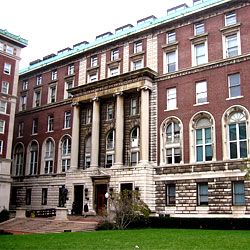
A word about Columbia J-School's 'Existential Crisis'

Former New York Sun editor Erica Orden wrote an interesting post today on New York magazine's Daily Intel blog entitled "Columbia J-School’s Existential Crisis," detailing the difficulties that the school is having adjusting to what it calls a "new media mindset."

Orden writes:

The media bloodbath hasn’t made for happy days at Columbia Journalism School. When the Times recently announced that its new, hyperlocal blog experiment “The Local” would be assisted by journalism students not from Columbia but from the City University of New York, you could practically hear the collective gasp echoing in the hallowed halls uptown. CUNY? Since when does CUNY trump Columbia? Well, since digital journalism became the single ray of hope on an otherwise dark media horizon, and Columbia’s vaunted ability to train students as print reporters began to appear obsolete. And so the school is trying to change. Fast.
To back up that statement, Orden notes the arrival of Bill Grueskin, former managing editor of WSJ.com, and the upcoming change in curriculum to focus more on digital endeavors -- which has, according to Orden, "raised the ire of some professors, particularly those closely tied to Columbia’s crown jewel, RW1."

“Fuck new media,” the coordinator of the RW1 program, Ari Goldman, said to his RW1 students on their first day of class, according to one student. Goldman, a former Times reporter and sixteen-year veteran RW1 professor, described new-media training as “playing with toys,” according to another student, and characterized the digital movement as “an experimentation in gadgetry.”

Orden goes on, accurately and with great detail, as to the "zero-sum" struggle of new media vs. old media resources; of hiring professors who know the former better than the latter and training those who know the latter and not the former.

Orden details the struggle at Columbia deftly:

Part of the problem is the perception that the situation is a “a zero-sum game,” as one person put it, where adding lessons in video production or law for bloggers will dilute or displace the school’s long-heralded focus on journalism’s core precepts: concise prose, ethical reporting, and sophisticated editorial sensibilities.

But the hurdles are practical as well as philosophical. Because many of the tenured professors haven’t worked in new media themselves, their classes require the addition of tech-savvy adjuncts, which has Lemann worried about “blowing out the budget.”

Orden wraps up the story with a sentiment I think all of us can agree on: that the real issue isn’t whether j-schools can afford to change, but that they can’t afford not to.

I believe this article reveals, faithfully, the administrative and honest struggle that journalism schools are having coping with a sudden rush of new media. The temptation to "dive in" headfirst without figuring out how to apply it, or without looking at return on investment for new storytelling methods. The struggle to convince "old media" journalism professors that new media is worthwhile, and vice-versa. 

It's a game of politics, but I think everyone is equally concerned for the same reasons: j-schools must continue cranking out the best journalists. But how?

I believe this article is framed incorrectly, however. The meat of the article is accurate, but the lede and the style used to make the point is misleading.

I've written before about my experience in the new media program at Columbia, and I mean in no way to be an apologist or defender of Orden's claims about the school. But I feel the obligation to clarify some of her inferences about and references to the school using the reality I experienced there.

  • The CUNY vs. Columbia "slight" in the lede is a creative way to play off Columbia's establishment position as the training ground for the New York Times, but Orden infers, without directly saying so, that Columbia has suddenly snapped out of its print mindset to catch up to the new media forerunners. 

    That's simply not true. The new media program has existed at Columbia, albeit in a much smaller form, since the 1990s. Much of its development is thanks to chief new media evangelist (and dean of students) Sree Sreenivasan, who has taught at the school since 1993. The program has evolved over time with the technology it covers, and has in recent years seen a noticeable bump in students who apply for the "new media" program. So it seems to me that the program has changed to address student demands, rather than trends in journalism directly.

  • Secondly, Orden credits Grueskin with that change, who arrived on June 4, 2008. I don't know firsthand just how much Grueskin has contributed behind the scenes. What I can say, however, is that the curriculum change for new media students was in the works long before he arrived, because Sreenivasan showed us a working draft of it sometime late that spring. 

  • As for RW1 -- Columbia's core reporting class, the nuts and bolts course -- Columbia "webified" the course for the first time for the school year 2007-2008, adding a content management system so that students could post their stories. Many of the difficulties Orden details about convincing old-time professors certainly do exist. However, Orden singles out one professor as an example of the skepticism -- and I must take issue with that. 

    I had the pleasure of taking a course from the professor that was singled out, and we produced a fine website for the class. In no way was my imagination limited by the professor with regard to that site. It's true that several professors at Columbia are new media tone deaf. And why should they be anything different? Some of them, particularly those of an advanced age, don't have a perceived need to be trained in new media. But that's not to say they aren't receptive to using it, even if they don't understand how to do it. 

    What's more, to debunk one of my own points, some of the oldest professors at Columbia are actively involved in the new media program. And I think that shows a lot of heart and willingness to learn, if nothing more.

  • Finally -- and most notably for Orden's lede -- the new media coordinator that she quotes was, prior to taking a full-time position at Columbia this past May, a new media adjunct at both CUNY Graduate School of Journalism and Columbia. For someone trying to start a new media war in her lede, that's a serious omission -- as are the other adjuncts who pull double-duty at both schools.

But Orden knows that -- she graduated from Columbia's j-school in 2006.

Still, I think the takeaway from Orden's post is far more valuable than the clarification I attempted to provide above. In every journalism school -- like as in every printed publication -- there's a generational, fight-or-flight, ROI-questioning debate about the place and weight with which we should approach new media and the storytelling techniques it provides. 

And for that reason, I believe we're all in this together -- it's not at all a race to be the "new media" king. Especially if the publications at the bleeding edge of adopting new media prefer computer science grads to journalism grads. 

Among j-school grads, I believe there's a kinship, a knowing bond that has developed from being in the experimental incubator together -- be it in New York, Missouri, California or Illinois (or Arizona, or Ohio, or...). From what I've seen, no one knows the answer to the great "new media" question -- especially j-schools. That's because the publications the schools are supposed to prepare their students for don't know, either. 

I don't want to appear as though I look through rosy lenses -- I have my criticisms of the journalism programs I have graduated from. But they seem to be far more prepared to handle the change than most of the publications I've worked for.

The policy is that there is no policy. As a journalist, I think that's wildly exciting.

UPDATE: Via Twitter, NYU's Jay Rosen directed me toward these meeting minutes from an NYU journalism school think session. It's a revealing look into what journalism educators are grappling with at this moment.

Friday, February 13, 2009

Tina Brown and the fight to save journalism

If you're a writer, get out of your comfort zone. 

If you're an editor, surround yourself with writers.

And if you're starting an online publication, do so with conviction. It will work.

Eventually.

Sage words from celebrated editor Tina Brown (Tatler, Vanity Fair, The New Yorker, Talk, and now The Daily Beast) last night at Columbia Journalism School's Delacorte Magazine Lecture, a weekly public lecture by notables in the publishing world put on by Victor Navasky of The Nation.

Brown's Daily Beast -- for which at least one friend of mine writes -- has been in the spotlight since its launch last fall. A new media venture by an old-media person, if you will.  An online pubication brave enough to not accept (interns aside) free work. A digital venture (questionably) backed by IAC's Barry Diller. 

But Brown revealed last night that the venture is very much her vehicle for figuring out how publishing can survive in a "free," online-only environment. Correction: not just survive, but thrive. And in this current state of media flux, it's exciting to me to know that someone is pursuing something with conviction, and not floundering about trying to stay afloat.

Highlights which I'd like to pass along to you, readers:
  • Deploying narrative journalism on the web successfully is Brown's greatest challenge.
  • The Daily Beast continues Brown's tradition of high/low coverage (or "class and trash," as I like to call it.)
  • Some of her best writers didn't start as writers at all. Some of her best writers were passionate about topics they weren't writing about for a living. It was Brown's challenge -- and naturally, to her benefit -- to correct this. Example: Dominick Dunne, whom she told to keep a diary; Jeffrey Toobin, whom she simply gave enough time to develop his own (less-than-legalese) voice.
  • Editors must "make their world writers," and surround themselves with them. They are immensely creative people, she said, and you must know their strengths and weaknesses and, of course, always have talent on hand.
  • A big area for development is in-depth, feature-length business journalism. Not closing-bell coverage, but CEO profiles and such things. "Capture characters," she said. 
  • The Daily Beast is doing what newsweeklies should be doing -- analysis and less breaking news coverage -- in the smart and intellectual way that Time, Newsweek and U.S. News & World Report are struggling to transition to at the moment. But, with the added benefit of linking off to the best of the web's stories.
  • The advantage of analysis: "People are gadflies, but they're also obsessives." So while hopping on the breaking news train is fine, people are still drawn to long-form, in-depth analysis telling them something they didn't already know.
  • "A good editor (at least, one in the vein of Tina Brown -- Ed.) likes a strong staff around them." Strong as in personality: "I have a terrible weakness for irritants."
  • Working online is actually less stressful/anxiety-ridden than print, because there are much fewer moments when someone's piece is cut because of limited space. "It's more physically grueling, but it's not as stressful in terms of disappointing people."
  • "It's so fashionable to trash the press all the time."
  • On the theory behind paying writers and investing in them: "You have to invest in people." Unlike her big-budget Conde Nast days, Brown can't hire writers on contract anymore, so the web environment makes it harder to develop people and give them a financial safety net at the same time. On the other hand, limitless space is helpful in that regard.
  • 2009 is the year of the freelancer. "The Gig Economy," she called it.
  • The Daily Beast has started to solicit advertisers, which will be its main revenue stream. Ads will appear in the spring.
  • On outsourcing journalism: "I think it's preposterous." 
Before attending, I knew little of Brown. I knew she and Arianna Huffington (The Huffington Post) were often cited as brash new editors-in-chief/publishers in the new media/online journalism world. I knew Brown had a fantastic pedigree. I knew she was British. 

But that's about it, honestly. So I was surprised when I heard these wise words come from someone who has been in the magazine business so long -- and who seemingly got into online publishing by necessity.

Brown spoke honestly and thoughtfully -- she wasn't there to publicize The Daily Beast, and didn't really reference it unless it was referred to in a question she was asked.

In listening to her opinions and advice, I came to respect her for this reason: she had a clear view of what she wanted and where she wanted it. An entrepreneur, she was pursuing publishing online, she wanted talented writers, she didn't want to cut corners nor spend funds happily. 

Personally, I don't like everything about The Daily Beast. (For one, I think its design, while adventurous, is a little hard to digest.). But I do now understand why things are the way they are on the site, and the thinking behind those decisions.

An old professor of mine likes to use the phrase, "Acts of commission, rather than acts of omission," when referencing online work. I can see that in operation at The Daily Beast.

Brown's vision may not be an ironclad business model, but it was her conviction that struck me. At a time when so many journalists -- newspapermen and women, freelance writers, editors, publishers, etc. -- are running to the next thing (blogs! Facebook! Twitter!) or just simply lamenting their own downfall (layoffs! cut pages! no ads!), I found it refreshing -- exciting, really -- to hear such a clear voice at such a cloudy time in journalism.

Friday, October 17, 2008

Andrew Sullivan: "Blogs Herald a Golden Era for Journalism"

Andrew Sullivan(Image credit: Trey Ratcliffe)

Senior editor Andrew Sullivan writes a wonderfully literary piece in The Atlantic about, well, why he blogs and why blogs are so important:

No columnist or reporter or novelist will have his minute shifts or constant small contradictions exposed as mercilessly as a blogger’s are. A columnist can ignore or duck a subject less noticeably than a blogger committing thoughts to pixels several times a day. A reporter can wait—must wait—until every source has confirmed. A novelist can spend months or years before committing words to the world. For bloggers, the deadline is always now. Blogging is therefore to writing what extreme sports are to athletics: more free-form, more accident-prone, less formal, more alive. It is, in many ways, writing out loud.

More here at The Atlantic's site -- and no, this four-page article is not in fact a blog, ironically enough. Still -- it's an eloquent explanation of why, as Sullivan puts it in his extended dek, "it heralds a golden era for journalism."

Thursday, September 25, 2008

C-SPAN launches ‘Debate Hub’ as social, political destination

Originally posted at ZDNet's The Toybox.

C-SPAN Debate Hub (click to enlarge)If you love using your gadgets -- and you're fired up about this year's election -- have I got a site for you.

Less than 24 hours before the first debate, C-SPAN, the cable network known for airing non-stop, unfiltered coverage of government proceedings, has unveiled its "Debate Hub," a social destination for the American public during the four presidential and vice-presidential debates leading up to this year's election.

The site allows users to follow the debate in near-real-time on their gadgets and simultaneously see how the Web is reacting to it. On the debate side, the site mashes up a transcript of the debate with video footage -- sort of like the New York Times -- and allows you to watch and share/embed clips of your choosing as the debate develops (it's on a 10-minute delay).

On the social networking side, the site casts a wide net and aggregates Twitter feeds and blogs on-the-fly and offers outgoing links to them. It's like a real-time showcase of how the 'Net is reacting to the debate, and it's the perfect way to utilize those gadgets on debate night: Twitter from your T-Mobile G1, blog from your Netbook -- and see it show up on C-SPAN's site.

Call it the ultimate elections app.

(The site is a sort of coming-out party for the network, who first jumped on the web with this year's Democratic and Republican National Conventions.)

A producer for the site, Ben O'Connell, tells me that the entire site was built using open-source software. It uses Wordpress as a platform and a MySQL backend on a Windows server. The clickable, color-coded timeline is based on SIMILE, an MIT project, and everything is built with "PHP, jQuery, and a lot of custom Javascript," O'Connell said.

Similar to Twitter itself, C-SPAN is pulling in tweets live from the Twitter Search API, tagged with "Obama," "McCain," "Palin," "Biden," "Barr," "Lehrer" (and "Brokaw" when he is moderating), "#debate08," and "#suspending." The site's got a small staff that will "monitor and include anything else that is trending and makes sense" throughout the course of the four debates, O'Connell said.

As for the sharable, embeddable videos, you can slice them the way you want, much like if you were using Final Cut Pro (note the green and red sliders in the second screen):

C-SPAN Debate Hub timeline

The site is designed by JESS3, whose principals, Zvi Band and Jesse Thomas, seem to have drawn inspiration from Edward Tufte's sparklines for the debate word clouds. I'm also told that the site has 14 people employed from New Media Strategies for outreach, monitoring and community engagement.

From what I've seen thus far -- it's tough, because the site won't really heat up until the first scheduled debate (9:00PM EST Friday) -- it's a great resource and a really neat way to text, Twitter, blog and otherwise engage on debate night on a much grander scale. C-SPAN's mission is to be in the public service, and it's clearly doing so here -- spotlighting the public discourse happening via mobile devices, with some fancy interactives for those who stop by.

Come debate night, tweet away.

Tuesday, September 23, 2008

Visual Proof That NYT Is New Media King

Local newspapers, take note: NYT's use of iPaper to show a city document on the City Room blog:


Integrating new software and trying new things is why they're still the online envy of media around the world.

Monday, September 08, 2008

Hard Copies of Newspapers, and the State of Journalism at NYU.

Is New York University behind the times in journalism education?

NYU student Alana Taylor made journalism news headlines last week with an interesting missive on PBS MediaShift about the journalism program at the university, once referred to merely as the "Department of Journalism" at NYU and now branded as the "Arthur L. Carter Journalism Institute" at NYU (with revamped curriculum to match), by stating that, in so many words, the NYU journalism curriculum doesn't serve the new media needs of a Generation Y student.

An undergraduate at NYU, Taylor blasts the paper-only mindset of the school, lamenting that she has to bring a hard copy of the New York Times with her to class, among other old-media, MSM things. The reaction around the journalistic blogosphere, acute and forceful, turned the barrel back on her for complaining. "You are wrong," "back to the NY Times," "learn how to write news" and "take some classes" were among the responses, criticizing her for being critical and generally missing her point entirely.

Well, this whole thing is not about her. It's about NYU.

A card-carrying Gen-Y'er, I found my love for journalism at NYU as an undergraduate, like Taylor. But when I attended, the curriculum was ad hoc at best, lenient and directionless with no ultimate goal. Had I not joined the school paper, the Washington Square News, I would never have been able to truly flex my journalistic muscle -- albeit in the old-style way, as in hard news -- nor befriend people on the same path, since the NYU journalism department was one of the largest majors at the university while I attended. My classes generally did not account for the computer as anything more than a tool for research. To most, it was not a publishing platform.

But, as evidenced in Taylor's description, NYU journalism is much better off than when I attended just two years ago. Yet it's clearly still not up to par.

Like Taylor, I'm new media-inclined, and I, too, blogged and "plugged in" as part of my journalistic experience there, mostly outside of class. I, too, complained about bringing a hard copy of the Times to class, because I read it online.

So, with all the "convergent" changes NYU has made, it is a valuable critique that the department's -- sorry, institute's -- new media instruction pales to the competition. Sure, Taylor is an undergraduate, and that group in particular receives far less specific training than the graduate level.

But when I attended NYU, the only new media class I took was called, amusingly, "digital journalism" -- and it was a blog-focused affair that looked at the ethics, practices, writing style and issues of online news and opinion taught by the affable Patrick Phillips, of I Want Media (another was taught by the media storm of a man that is Jay Rosen). And this was all in 2006.

So, in two years -- light years for the Internet, and just look at any webpage from 2006 to see it -- NYU's new media outlook hasn't changed that much. It's lamentable.

I was lucky enough to attend Columbia's Graduate School of Journalism after NYU, for new media. And one of the reasons I attended was to do everything I wasn't able to only had a taste of as an undergraduate at NYU. Video, audio, interactive design, blogging -- that was something I used to do in my spare time. At Columbia, I did it for my degree. At NYU, it was a grand experiment in an entire class blogging.

NYU's undergraduates either study "general and investigative reporting" or "media criticism," and graduates study one of 10 subject-related fields. Columbia's M.S. graduates study "print," "broadcast," "magazine" or "new media," and it's M.A. graduates delve into the subject-specific matter.

I don't intend to compare NYU's undergraduate curriculum with Columbia's graduate instruction as apples-to-apples. I merely want to show how radically different an experience can be in just one year's time, from one school to the next. How different an approach to journalism education can be with regard to categories.

Categories or not, Taylor's taking to the challenge by learning on her own, like I did. Good for her, I say. She knows she's ahead of the curve anyway, and she's getting an education by learning what she doesn't like.

So why is NYU behind? Allow me to posture. From what I've seen as a student, lots of staff changes in recent years, with a revamped curriculum (undergrad and grad) and a new building entirely. NYU's journalism school is a department within the greater College of Arts and Science, so it does not have the dedicated resources that it would if it were a separate school, instead bureaucratic red tape and a lack of funds. The department's never had much of an identity (a "department" is now "the institute," which helps greatly) and, given its size, hardly any community at all, with a serious lack of alumni relations (and I mean no disservice to the single alumni coordinator).

I was speaking with a former editor-in-chief of WSN, and we agreed that, had we not joined the paper, which is (was) not promoted by the department at all, we would never have made journalism student friends. Which is hard to believe, since j-students are a tight-knit, give-a-helping-hand group of professionals. When I simultaneously created NYU and Columbia journalism groups on LinkedIn, the popular networking site, the "join rate" of Columbia's dwarfed NYU's, even though Columbia is a much smaller program and lacks undergraduates entirely. (To date, Columbia's has 130 members, while NYU's a paltry 24).

The reason I say all this is because NYU's journalism program is in the midst of profound change -- much like the kind of change newspapers are going through all over the country, one of identity and mission. The department is turning a corner, slowly, but it remains to be seen if Taylor's concerns about new media are a part of the new direction of the department. Perhaps there is no reliable system of feedback for its own, many, graduates. Sure, NYU now has great new facilities for such instruction, but is it actually a part of the practical, bootstrap, nuts-and-bolts instruction? Apparently not, according to Taylor. And that's a real shame, because there exists few journalists in this world that don't have digital copies of their clips these days.

I don't fault anyone for not knowing Mashable -- as popular as it is, it's easy to miss. But to not account for a journalism student's desire to eventually write for the web -- and not a paper, or magazine, etc. -- that's bad news in my book.

Oh, and you know what, Alana? In all my time at NYU and Columbia, I've only read a paper New York Times twice (I read it several times a day online). Both times, NYU professors were "to blame." But I'm happy I had to, just those couple of times. It's easy to forget how some people read the news.

But there's a vice-versa to that, too.

(Much thanks to Lam Vo and Simon Owens at Bloggasm for the heads-up on this.)

Tuesday, April 08, 2008

Wanna Be A Journalist? Prepare For The Online Sweatshop.

The New York Times recently published an article about what new, young, 'Net-savvy journalists face in the industry today: complete web exploitation.

A growing work force of home-office laborers and entrepreneurs, armed with computers and smartphones and wired to the hilt, are toiling under great physical and emotional stress created by the around-the-clock Internet economy that demands a constant stream of news and comment.

Of course, the bloggers can work elsewhere, and they profess a love of the nonstop action and perhaps the chance to create a global media outlet without a major up-front investment. At the same time, some are starting to wonder if something has gone very wrong. In the last few months, two among their ranks have died suddenly.

A young friend of mine is featured as one of these new digital sweatshop employees, so this wasn't news to me. But I (and the Times, apparently) find it to be a growing trend among up-and-coming journalists who know their way around a computer.

"Let 'em blog on the website," a young intern hopes to hear at the Anytown Daily News or National Monthly Magazine. And why not? It's a great way to get clips, and the publication's less-than-Web-savvy staff get to avoid learning anything more about the mysterious Internet, thus keeping their jobs secure. But then the abuse begins.

"Can we put an original picture up with that?" the editor asks. "Can we move that text over here?" "Can't we add a video to that? How about some of that flashy Flash stuff? The big boss really loves that online magic stuff, and will really like this at the meeting today," the editor says, thinking of that raise for "managing the Website." But without any familiarity of how long it takes to do such things -- such as create interactives, log and capture video, and make sure it's all perfect before posting to the Web -- the editor has made our lowly, new, tech-savvy journalist an overworked, underpaid, stressed-out multimedia producer.

And that's where the industry model is right now -- take a look at your favorite blogs. Do a little Google search on the ones that update at a rapid clip. Guess who's manning the keyboard? (Here's a hint: It's not Malcolm Gladwell.)

So when the Times pointed this phenomenon out, it hit the Web by storm. But anyone who knows anyone at Nick Denton's Gawker Media or any competing online-only startup knows that the digital sweatshop has been around for years.

"Well, when I was a young journalist, I had to pay my dues too!" the old editor would say. And that's true -- but something tells me that wasn't on a 24/7/365 publishing cycle.

Tech-savvy readers: Have you been taken advantage of? Let us know anonymously (or not!) in the comments.

Thursday, February 07, 2008

Visually, WashPo's 'The Root' Looks Exactly Like...A Root.

What does a root look like?

It looks exactly like what science would intend for something dug out of the ground, that's what. Which is precisely what the Washington Post's new online-only venture, "The Root," conveys at first glance.

Kind of dirty, not really cleaned up, does its job and lets leaves be leaves. (well, sort of.)

Sure, roots are tenacious. They are stable. They are dependable and anchor us. And so is the concept behind this interactive endeavor.

But one thing David Sarno didn't mention in his Los Angeles Times review of The Root, among all of the shortcomings in reporting and the star-studded staff on board for the project, is how absolutely terrible the website looks.

The design? Blocky, with colors that evoke, deliberately or not, Ancestry.com.
The images? Basic (and not very arresting).
The layout? Look at all those columns. Look at all that wasted space. Look how poor the navigation is. And for God's sake, look how far you have to scroll to get to the bottom of the page.

What is this, a blog?

And The Root is online-only! It is supposed to answer to no printed deity from high above. Even with only four people staffing the small project, it's clear that the Washington Post didn't make design a priority. For a project that comes from the interactive department, that's a mistake.

Sarno alludes to it in his review. "Visually and tonally, the Root seems to be going for a stately, moderate approach," he writes. Which is a real nice way of saying, boy oh boy, a big national newspaper gives itself a chance to break its own established mold of text-heavy, amateurish design slips and...we get this. A website that looks like one I created for kicks in middle school (And now I'm revealing my age, aren't I?)

I'm sorry to be so vehement about this project. But despite all the great content promised, I don't think the Washington Post Co. should have let this website launch until...it looked like a website made in 2008. Instead, it looks like someone took a CMS (Content Management System for non-technophiles) and went haywire.

It's confusing. It's bottom-heavy. And it's not eye-catching at all.

The Los Angeles Times' headline for Sarno's review was, "The Root doesn't reach far from the tree." And in this case, they're right about that, too.

For a stab at new media, The Root sure looks old.

Wednesday, August 22, 2007

Columbia J-School Moves Toward New Media, "Tradigital" Journalist

Columbia University Graduate School of Journalism isn't exactly thought of as a school on the bleeding edge. After all, with all of its history and close-ties to mainstream media, it's rarely expected to be the preferred choice of the blogger-cum-citizen journalist set, and of all things, it's headed by a guy who has been deemed the "Pope of MSM."

(In full disclosure, that didn't stop me from attending, however.)

But today I sensed a new change at Columbia, months after Northwestern's Medill School of Journalism decided to revamp the entire curriculum. Today, I was told that the "New Media Newsroom" class for "New Media" majors and interested non-majors (such as broadcast, newspaper or magazine) was under the close watch of Dean Nick Lemann -- yes, the aformentioned Pope -- and a series of affiliated committees with interest in the school. It's the "most watched class," apparently, and "Dean Lemann's baby."

Hmm. For a man who penned "Amateur Hour" in The New Yorker, that's an interesting change, no?

This year, for the first time in the school's history, "New Media" majors were brought in two weeks earlier than newspaper and magazine concentrators to learn production techniques for websites, flash, photography, audio recording and video editing. In addition, the school-wide required Reporting and Writing I class now includes a "web-ified" element to it.

Pulitzer Prize administrator Sig Gissler summed up the outlook perfectly with his own coined term: "The tradigital journalist."

Has the "gray lady" of journalism academe finally come around on the topic of a new journalist guard? Or was Lemann too-quickly judged by more technologically savvy critics such as NYU/PressThink's Jay Rosen and CUNY/BuzzMachine's Jeff Jarvis?

Is Columbia's perception as a slow-moving traditionalist truly accurate?

I don't know, and due to my affiliation, I'm happy to avoid passing judgment. I await reading others' thoughts. But what I can say is that the tide change is readily apparent in the halls, and it's no secret that students from the others sections have expressed demand for new media skills.

Is Lemann backing down his criticism of amateur journalists in the field by teaching his own students the techniques they use to scoop MSM?