Showing posts with label blogs. Show all posts

Friday, October 17, 2008

Andrew Sullivan: "Blogs Herald a Golden Era for Journalism"

Andrew Sullivan(Image credit: Trey Ratcliffe)

Senior editor Andrew Sullivan writes a wonderfully literary piece in The Atlantic about, well, why he blogs and why blogs are so important:

No columnist or reporter or novelist will have his minute shifts or constant small contradictions exposed as mercilessly as a blogger’s are. A columnist can ignore or duck a subject less noticeably than a blogger committing thoughts to pixels several times a day. A reporter can wait—must wait—until every source has confirmed. A novelist can spend months or years before committing words to the world. For bloggers, the deadline is always now. Blogging is therefore to writing what extreme sports are to athletics: more free-form, more accident-prone, less formal, more alive. It is, in many ways, writing out loud.

More here at The Atlantic's site -- and no, this four-page article is not in fact a blog, ironically enough. Still -- it's an eloquent explanation of why, as Sullivan puts it in his extended dek, "it heralds a golden era for journalism."

Monday, January 07, 2008

Can A Blog Hold A Paper Publicly Accountable Like An Ombudsman?

The Baltimore Sun just canned its ombud position and replaced it with a Q&A blog. Does that sound like an equal-value replacement?

A memor from publisher Tim Ryan, via Poynter:

As you know, communication with our readers is very important to us. Although we will not fill the public editor position, we will continue to take steps to ensure interaction with our readers:

We will launch a new blog on baltimoresun.com, offering readers the opportunity to ask questions and comment about our coverage. [Former public editor] Paul will moderate this blog and coordinate responses from the senior editors. We will post the reader comments and our responses on the blog each weekday.

Now here are two questions I have about this move:

One, since when is the paper's ombud a liason with readers? I always thought the public editor position was intended to hold the paper accountable by someone who fully understood its workings.

Two, is a Q&A blog really a match of a replacement for an ombud? Sure, a Q&A blog may help some give-and-take between the paper and readers (even though questions are edited and selected by the paper). But can it still hold the paper accountable? Not to deny Sun readers valid points, but is the kind of person that would respond to a blog Q&A the same kind of person that could make the points that an ombudsman does?

To me, it seems like there's an inadvertent bait-and-switch -- you know, like exchanging checks and balances for the impression of tech-savvy transparency -- and it seems like the Baltimore Sun took back some power it had given to entities not affiliated with the newsroom.

Just some food for thought. Happy 2008.

Wednesday, September 12, 2007

Newsflash, Mainstream Media -- Blogs Can Backfire

I was browsing my RSS feeds earlier today when I saw a post about the new Wu-Tang Clan album on MTV News' "You R Here" blog. "Wu-Tang Album Sneak Peek," the headline of the post written by intern Steven Roberts announced on my reader. So I clicked, interested.

Roberts began with the following "just an intern" angle, which lent itself well to the subject at hand:

I’ve been interning at MTV News for about three weeks and I already loved it, but when senior producer/hip-hop brain trust member Rahman Dukes asked if I wanted go with him to a sneak peek at the Wu-Tang Clan’s new album, The 8 Diagrams, that was the clincher. I played it cool and told him “sure,” but secretly I was thinking “hell yeah!”

But reading onward, it becomes painfully clear that Roberts doesn't quite exercise enough writing chops, ending paragraphs with material like "For the next 20 minutes, we sat in amazement" before starting the next graf with a copycat "The production on the sampler was amazing," as well as littering his congratulatory copy (not a single criticism in the whole thing) with exclamation points and other throwaway adjectives.

What am I trying to say here? Well, I'm certainly not here to bust intern Roberts' chops. But reading this unedited text made me cringe. MTV News is supposed to be pretty good at giving the music news goods, aren't they? So what's this doing on their site? Blessed with a high-profile review and a great opportunity for an intern, Roberts managed to get his text on the site apparently without passing it through an editor's hands, or even a peer's, and I think it reflects less than positively on the part of MTV.

MTV, it seems, jumped into having its interns blog without really setting oversight -- and in turn, without seeing what the consequences could be.

On the surface, having your interns blog is a fabulous idea. It's a great way for a quick byline and it keeps the site up on daily events without bothering other editors with the task. It's the perfect place to get tangible results, especially for a Webified generation. I support it wholeheartedly.

However, one must be careful about how quickly things can be published online. That's right, "published." Even if it's a blog, it's on the same level as the standard news content that the site offers. My RSS reader doesn't discriminate.

Which means behind the scenes, MTV should be doing just that -- discriminating. Teach those interns that even blogs need to be held to a standard, and help them learn how to achieve that. Blog-style writing can be chatty and informal -- but it can't be poor. And I think that's one reason why for MTV -- and any other mainstream media outlet that jumped in too quickly -- blogs can backfire.

Tuesday, July 10, 2007

Taking Responsibility: How The Sacramento Bee Protected The Hive's Freedom Of Speech

Remember the old controversy over whether or not a news publication should audit its online comments?

About two years ago, the Washington Post ran into just that problem when it literally turned the function off after the usual stock of personal attacks and profanity showed up on its pages. Bloggers were furious, citing a violation of their own virtual First Amendment, and news hounds were appalled that the Post would stifle the voice of its readers.

At the time, washingtonpost.com executive editor Jim Brady wrote, "We're not giving up on the concept of having a healthy public dialogue with our readers, but this experience shows that we need to think more carefully about how we do it."

Two years later, the Sacramento Bee might have just figured it out.

A new policy at the Bee requires full names attached with online comments. Old-guard 'netphiles would argue that this ruins the anonymity of the Internet, but in the Bee's eyes, it introduces responsibility. After all, if you're going to take the time to say something, you should take responsibility for it, no?

As a result, the Bee is no longer vetting comments. In this case, that's great -- it rids of the need for such energy and time to do so and gets Bee staffers back on the important stuff: the news. Plus, any time a newspaper steps away from appearing like a God-like authoritative figure ("I am the decider"), that's a good thing.

However, the current worry is that staffers within places like government institutions won't have the freedom to comment without fear of repercussions.

But you know what I say to that? Baloney.

If a government staffer or any other insider has something important to say -- and doesn't want to just correct reader discussion for the sake of it -- he or she should simply e-mail the paper. Allow the paper to take anything important public, under the veil of anonymity. Isn't that what the paper's for?

If the Bee is worried that they won't get any more tips, they should introduce a special tip-off e-mail address that guarantees anonymity -- kind of like how The Consumerist treats its tipsters. If something's important, a well-written article would probably break more news than one comment among hundreds on a story.

So many news agencies are worried about how to handle the citizen masses. "But they'll curse!" they say. "But they'll be racist!" they say. Ah -- but when their name is attached, a digital trail may soon form, and they'll dig their own grave.

But I'm still stuck on this nuance: How exactly will the Bee ensure the use of a legitimate name? Or will this turn into a bunch of flamewars between "Billary Clinton" and "Hick Cheney"? I don't know.

But what I do know is that this action is not an overreaction nor infringing on freedom of speech. I applaud the Bee. If you want your freedom, stand up and claim it. Last time I checked, the Constitution doesn't guarantee you anonymity with it.

Tuesday, April 03, 2007

"The Graduates" Fails To Make The Grade

Yesterday, the New York Times launched a new opinion blog, "The Graduates," intended to relay the fears of eight college seniors facing the future. I think it's the best idea I've seen in The Times in awhile - but I think it's the worst execution I've seen in the Times in that same period of time.

There are two primary reasons why "The Graduates" is different from the other Times blogs: first, it's written by eight students who (to my knowledge) are not employed or paid by The Times; second, it's written by eight people presumably under age 25. This combination of citizen journalism and classic MSM journalism is highly unusual for the Gray Lady, but very cool nonetheless.

Not surprisingly, all eight graduates are journalism or communications majorswrite for the campus newspaper: Alice Mathias is a columnist at Dartmouth, Amber Wilson is an editor at Dillar, Anna Weggel is an editor at the University of Minnesota, Juliet Moser is a columnist at George Washington, Michael Erler is a columnist at San Diego State, Missy Kurzweil is a columnist at Cornell, Travis Mitchell is a columnist at Texas A&M and Tyler Graf is an editor at the University of Oregon.

So when I read Ms. Mathias's first post yesterday, in which she proclaimed that she was "magically reporting for a not-student-run news organization from the trenches" of her last semester at Dartmouth and mentioned that "on June 10th this [safe, town-sized] bubble is scheduled to burst, at which point, along with (most of) the class of 2007, [she] will be catapulted into adulthood," I couldn't help but think:

Since when aren't you an adult? Don't you have real concerns?

Are you really running around Hanover as a child with an Ivy diaper?

I imagine Ms. Mathias is not, but something still struck me as odd about her post: Though written eloquently, the content was not at all telling of her fears. In fact, there weren't really any hard facts or anecdotes in the whole thing. Ms. Mathias, it seems, was merely a self-appointed mouthpiece for her class and generation, worried about who will be president and what we're going to do with our lives.

"What color is your parachute?"
"I don't know, I'm too busy crushing for Barack Obama."


So what, then, was the point of this blog? Tell me about the kid who struggled through Dartmouth because he didn't get enough financial aid. Tell me about the kid whose parents divorced months before his graduation. Tell me about the kid who is $10,000 in credit card debt and $100,000 in debt from Sallie Mae federal loans. Tell me about the kid who is scrambling to get her sprained knee and three cavities taken care of because his Mom just lost her job and she's without medical or dental insurance upon graduation.

You can tell me about the dreams of a college graduate, but tell me some reality, too. Otherwise, what's the point?

Though there are only two posts on the blog so far - Ms. Mathias's and today's post by Mr. Mitchell - both convey a less-than-grounded approach to breaking out and actually working as a journalist (or anything else, for that matter). In her post, Ms. Mathias concerns herself with a childhood game she used to play that would "forecast" what life she was destined to live. Mr. Mitchell's post is equally as rose-tinted, as if it were written by an elementary school child with a fantastic grasp of vocabulary. Though many of their sentences start of with a wide-sweeping negative proclamation like "only a few will be prepared" or "if my classmates and I are going to live forever," there isn't any real discussion of the real difficulties each student will have when they graduate.

Trust fund babies as an exception - and they should be, even if it is The Times - what about health insurance? How about a job? Are you going to move out of your collegiate city for another, or stay? How is your journalism/communications degree helping or hurting you? Have you found an apartment yet? What about the psychological aspects of being a legal independent? Living on your own? Doing your own taxes? Paying for graduate school - alone?

In my opinion, "The Graduates" is a stellar opportunity for not only these eight seniors, but all of the class of 2007 and beyond - yet I fear the opportunity will be wasted on writings of high-flying dreams, hopes and aspirations. Not that those aren't important - they're what get you through the day and are worth living for, believe me - but I think some real tough-love posts are due on this new blog. Otherwise, what's there to be scared of? The next president?

To boot, the blog is only available on TimesSelect, and though The Times has recently made the service free for those with a ".edu" address, few know about it and fewer know how to activate it (I did only recently, and I consider myself 'in the know'). Plus, TimesSelect expires when you graduate - so all eight of these seniors won't be able to read their own blog writing after May.

Additionally, it's nearly impossible to find, and isn't yet listed in The Times' own blogroll.

In the end, I think "The Graduates" misses the mark by not practicing what it's assumedly preaching. You can find real honesty and worries buried in message boards all over the Internet - why can't that reality be pushed into the spotlight?

A better way to do it? Select some students who aren't afraid to write honestly. Journalism students might be good writers, but writing for The Times, they're far too concerned with how they appear under such a masthead. Get the word out to major colleges and universities that the blog exists (since apparently, "no young people read the newspaper anymore") and let the comments build. But most importantly, just get the word out - it's not like students don't want to speak about their problems. (And those problems are not about whether Family Vacation or Animal House is a better movie, either.)

In the end, make sure everyone of every age reads it - because the Class of 2007 is sick of reading about how they're burdened by debt, job prospects and politics from people who are old enough to be their parents.

Let them speak for themselves. And let them speak the truth.

Thursday, March 29, 2007

The New York Times Should Pick a Young Dark Horse for Public Editor

Slate's Jack Shafer wants the New York Times' new public editor to be under 40. And I think he's right.

Jack says it's because his or her "worldview hasn't been Lasiked blind by decades inside a newspaper newsroom, and who writes the way fire ants bite."

And I say he's on the money (AJR's Carl Sessions Stepp thinks so too). But I think his list of suggestions goes a little too extreme, reflecting a desire to steer toward the Web without concern for actual editing psychology.

(As a side note, I don't always agree with Shafer, but I do read his columns often, and I'm always impressed with his handle of history and ability to shape an argument. I think he's one of the finest writers out there.)

Though Shafer's list mentions some qualified journalists in magazines and newspapers (Joshua Green, Larissa MacFarquhar, Michele Cottle), it also emphasizes the first honorary blog class of media: Elizabeth Spiers of Gawker/Dealbreaker fame and Joshua Micah Marshall of Talking Points Memo.

And you know what? Those are some stellar big names in the industry. But as an ombudsman? A public editor? I don't know. Just because you write opinion all the time and got famous for it doesn't mean you're qualified to do it and do it well.

Let's take Spiers as an example. When I met her, she seemed far less concerned with editorial pursuits than with business models, and she mentioned that business was her groove and not gossip. Spiers will make a fine publisher - hell, she already is on that track with Dead Horse Media - who is savvy to editorial feel. But as a public editor? Spiers made her name spitting bile for Gawker, but I don't know if she's really cares to critique the many aspects of The Times for the benefit of The Times. For her, the question isn't whether The Times can afford her, the questions are whether she'd really care to backtrack to old habits and whether the Times is getting the best bang for its buck. She won't be afraid to step on toes or cut them off entirely- but will she be right?

And that's just one of Shafer's examples. I think Shafer's sentiment behind the suggestions is great - look to the web, look away from the old guard - but I must caution that we needn't swing all the way over so quickly. It's as if Lockhart Steele hired Howard Kurtz to be Gawker's public editor. How would Alex Balk feel then?

In my opinion, I think the Times should hire an unknown; a dark horse. I don't think you're going to find a solid opinion in someone's clips - I think it will have to emerge from a lengthy conversation about the paper. After all, why would a great reporter translate into a great ombudsman? Wouldn't a good editor be better?

And how do bloggers fit into the mix? I certainly don't think calling out Anna Wintour through a gossip blog necessarily qualifies someone to critique coverage on the war in Iraq. So really, you need to find someone who cares passionately about journalism, without getting caught up in the mundane or the profane.

Let's go a step further: How should a journalism degree fit into this? Should we move to elect people who have had guaranteed exposure from an Ivory Tower? Should The Times just hire Jay Rosen and be done with it?

It's not an easy decision no matter what. So frankly, I think The Times should have a big write-off: open the field to all comers, make them all write on a specific issue, and see how they do. Then pick your editor.

A public editor needn't have star power - just a critical eye and a fluid pen.

EDIT: Gawker, of course, came up with their own list in response to Shafer's column - not surprisingly with their own staffers and favorite punching bags.

Tuesday, February 27, 2007

FastCompany Magazine Is More 'Company' Than 'Magazine'

Never let a business touch a journalist's publication.

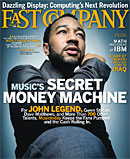
Last week, I had the grand opportunity to attend 'Backstage with John Legend,' a panel on music entrepreneurship and how artists are grabbing hold of their own careers in an age where intellectual property is hard to manage. The event was sponsored by FastCompany, a business-centric magazine that I thought was an upstart until I was told that the magazine had been around for 10 years but never really took off "thanks to mismanagement and poor business decisions."

At the end of the event, which was cordial, informal and altogether a relaxing good time (and educational, at that), I spoke with Dave Wolter, V.P. of A&R at Capitol Music Group and one of the night's five panelists that included Nathan Hubbard, CEO of Musictoday; Jorge Just, netroots manager for indie rockers OK Go; and Jason King, Artistic Director of the Clive Davis Department of Recorded Music in the Tisch School of the Arts at New York University (and my professor).

I spoke with Dave to simply say that I thought he was brave to be the music-label punching bag at an event where most of the panelists were shrugging off record companies entirely. I myself don't support the copyright-enforcing practices of his industry, but there are open-minded people who work at record labels, and I thought he spoke with an open mind instead of towing the industry line.

I also spoke with him about my own hard rock band, Dibble Edge, and asked him what he thought of the state of rock n' roll in modern music. He was reassuring - rock bands are still alive and thriving, despite the reduction of airtime on radio. He also reminded me to not count out MySpace, which many have said might become useless as a result of too many bands on the site.

Afterward, I spoke with FastCompany's Alex Pasquariello, who interviewed me and a classmate about the event. He promised both of us a mention in the blog post he was to write, and asked us basic questions that we both answered quite intelligently, given that we were taking a class on the same subject from one of the panelists.

The next morning, a huge post went up on FastCompany's site, but there was nary a mention of me or my classmate, neither the points we were trying to make. But he did, however, link (by request!) to the old OK Go video talked about during the event, but a new one not even mentioned that night, and used a good portion of the blog's word count to do so.

I figured, well, maybe Alex ran out of space. It's no big deal, even though he repeatedly promised. So I summed up what I spoke to Dave about in a few well-structured, linked sentences and posted it as a comment.

It never appeared.

FastCompany rejected my educational comment that augmented the very points he was making in his post.

But he didn't, however, reject a trolled comment that was a full-on pitch for someone else's business:

Hi. I am Javier, the founder of Trendirama.com, a community of online amateur writers. We write about the future of everything, and I would like to invite you guys to write an article on the Trendirama.com website, perhaps "The future of music in the US" or whatever you are passionate about? It is up to you, you choose the subject. You would get a link back when you link to your own article, if you wish. You can even re-use some of what you have here, in the last part of the article, "your view and comments". That would save you time and still be interesting for readers. Don’t underestimate this opportunity!
Public be warned: Alex Pasquariello is not a journalist, and FastCompany is not an independent magazine.

Neither one subscribes to basic writing style, or worse, ethics. Journalistically, FastCompany is no better than an in-flight magazine in receiving influence from the very people it covers.

According to their website:

Fast Company magazine is celebrating its 10th anniversary. Launched in November 1995 by Alan Webber and Bill Taylor, two former Harvard Business Review editors, the magazine was founded on a single premise: A global revolution was changing business, and business was changing the world. Fast Company set out to chronicle how a new breed of companies create and compete, to highlight new business practices, and to showcase the teams and individuals who are reinventing business. Today, the business world continues to change, and Fast Company continues to evolve as well.

And according to editor Mark Vamos:

Our mission is to find the creative workers and organizations that are building the future, and to present their stories in smart, compelling, beautiful, and useful ways. This mission is the core of the magazine's original DNA; it's the brilliant bit that differentiates us from all the other business magazines out there.

No, Mark. The difference is that the other business magazines hire business journalists, not journalist businessmen.

It's not the rejection of my comment that infuriates me. In the grand scheme of things, I don't really care. Really, it is the blatant courting by a magazine of its own subjects under the premise that what the magazine is practicing is journalism. If this is how a magazine operates its blog, how can I expect any better from the magazine proper?

Many established consumer magazines straddle the line between influence and influenced - fashion magazines especially - but advocacy is different than explicit ignorance. To the magazine's defense, I did read through the issue they had at hand, and the articles weren't bad. But who is writing them?

Nevertheless, the blog comment rejection came right after a panel event where the main topic was how artists can embrace their fans directly. Ha! How can a magazine gain new readers when it won't even post an educated, concise response from a mostly unaffiliated person who attended their invite-only event?

FastCompany, it's no surprise that even after a decade, no one has heard of you.

Thursday, February 22, 2007

Pride In The Name of News

If you care about getting the news in a timely fashion, there is no reason to read a newspaper.

Spot news, it seems, is disappearing from the pages and moving to the screens.

A recent New York Times newsroom memo from Bill Keller announced that the Internet will be key to 2008 political coverage:

For this Presidential election cycle we are organizing our coverage in a new (for us) way: for the first time, a central political desk will supervise coverage for the newspaper and the web. This new desk will include not only newspaper editors, but also people with experience in web production, database reporting and software development. Newspaper and online journalism will get equal emphasis — we are well past the day when we can think of ourselves as a newspaper with a Web site on the side — for an audience that now expects its political news to arrive in full multimedia, interactive glory.

The goal is to develop a seamless operation that can feed our blog and home page with breaking news all day long, produce innovative and value-added multimedia and database reports -- and then deliver the smartest, freshest possible stories to our newsprint readers the next morning.
Basically, Keller and Co. have reorganized the way instant-news is produced at The Times. He's placed equality between the paper and the website, and as far as political stories go, he values the benefit of clickable electoral maps, live-voting feeds and comparison charts that aren't truncated to fit a peice of paper.

As I've mentioned before, this change at The Times is indicative of a new way to do the news: Internet first, paper second. And it's more profitable than critics think.

Web journalism has finally found its reporters. And it seems they're more inclined than ever to be versed in web production, multimedia and traditional reporting savvy.

The future is clearer than we think: spot news will reside online, and adventurous, well-rounded journalists will helm the ship.

Conversely, expect to see a change in the very basic format of writing a news story: half-reported stories will rarely make it to the page, and analysis will become a critical component of a basic news story - the real reason people will keep reading a publication.

The "news" in "newspaper" is now a relative term: it's news to anyone who hasn't read the website.

Will newspapers save the big, muckraking stories for the printed page? Maybe, if they think no one else has the story. But if a newspaper smells competition, don't expect to see any "exclusives" on the printed page.

For newspapers who pride themselves on getting a story first (and being cited as so), posting it online with a timestamp is the new proof of bleeding-edge legitimacy.

After all, aren't newspapers sick of citing blogs as the first sources for stories?

Tuesday, February 20, 2007

Why More Journalism Isn't Better For Journalism

"What we have here is....failure to communicate." Captain, Cool Hand Luke

Options, options, everywhere.

My blog RSS aggregator is getting embarassingly cluttered with new blogs I like - but many of them overlap to the point that I would consider dropping a few and keeping only the more comprehensive ones.

The New York Times and the Washington Post have an awful lot of new blogs, too...some covering each other.

Meanwhile, I've only got two eyeballs and 24 hours in a day. I can safely say I read more news than the average reader, but there's a limit to how much I can digest.

I can't read them all...so why do I read what I read?

That's the question newspaper publishers need to ask their readers - and themselves - when they hand down job cuts from above.

"If you lower the amount of money spent in the newsroom, then pretty soon the news product becomes so bad that you begin to lose money," said advertising professor Esther Thorson of the University of Missouri's journalism school.

It seems to me that, when the ranks of newsrooms are thinning, the editorial options are exploding. How can papers afford new blogs, new online video, new podcasts, etc. - things that do not directly replace elements from the traditional newspaper - when they have less staff than ever before?

Have they installed beds in the newsroom yet?

And does it matter? Is anyone even reading the new stuff? (Or paying for it, advertisers?)

A recent column by a friend of mine highlighted his newspaper's lack of an ombudsman. Given the paper's limited financial state, it's understandable. However, the paper struggles with quality because it doesn't have the cash to hire enough people. Everyone's outstretched and doing the job of two staffers - and the paper is often a veritable mess of typos and poor editorial choice the next day. Yet they've recently expanded their online presence quite a bit - and I know for a fact that there's no "online editor" at the paper.

In the long-term, how can this be a solution for a newsroom? How can a publisher or an owner expect the employed journalist to write, edit, record, or shoot even more?

Isn't it better to have five pages of solid, thorough writing than 15 of cliche-ridden copy?

When is the point where we remember what a publication's goal really is - inform instead of meet the deadline? I know deadlines are important and readers trust that a paper will be out at the same time each day - but I'm starting to lose trust in the quality of writing crammed in.

It's the same reason why I cut this blog back to twice-a-week posts from daily posts.

On one of the financial blogs I subscribe to, I read once that a better solution to earning wealth isn't cutting costs so much as raising revenue. That is, while it's important to track expenses, there's a boundary of quality of life that we shouldn't breach. If you keep cutting corners, you won't have any paper left.

Publishers should take heed. Some of my favorite newspapers are losing their cachet, and I really don't think it's because journalists are less talented. They're just outstretched.

And the jury's still out on whether all that extra work is bringing in more profit.