Showing posts with label NYU. Show all posts

Thursday, October 09, 2008

Update: NYT's Failure To Credit Original Writer

In response to my previous post complaining of NYT's lack of link to New York Post photographer Jason Nicholas' debut as a New York story, NYU Local, an upstart campus publication, questioned the rules of attribution online for a story. After all, if one publication breaks the story of a person once unknown, can a larger publication pretend that the person remains unknown to its own audience, and start the introduction over?

And moreover, what's the etiquette for linking online to such things? Should we preserve a breadcrumb trail?

With these issues in mind, I decided to respond to the exchange on NYU Local's site, in which City Room editor Patrick LaForge dashed off a comment, sans link, to NYU Local City Editor Nicole He's post:

Hi,

The blog article in question does in fact link to the Washington Square News article.
We were unaware of that article — which, as this post notes, is not about Mr. Nicholas’s current legal troubles but about his past and his graduation. When a commenter pointed it out, we added the link, within hours if not minutes of publication. It is our policy to credit other sources, and we have.

Patrick LaForge
City Room editor

But LaForge is incorrect -- there exists no link to WSN on that post, which He confirmed in a follow-up comment:

Hi Mr. LaForge,

We took another look at the article in question (this one, yes?), and we can’t find any link to the Washington Square News, except in a comment left by Mr. Nusca. If you can show us where the link is, we’ll be glad to run a correction.

The link is still absent, as of 11:15 a.m. on Oct. 9. So I decided to respond. Of course, it's not the simple oversight of a link that I'm frustrated about -- it's easy to say I'm biased toward my own clips, naturally -- but the general idea of what function the City Room serves to its readers, the Times and the greater New York press scene. And, of course, the continual and complete failure of the Times to acknowledge wrongdoing, even if trivial:

Nicole,

You are correct in your assessment. There is no link to the WSN story.

The only additional link that appears in the City Room blog post is one to an article by Lincoln Anderson in Downtown Express, not the piece I wrote in the Washington Square News.

You raise a good point in this post with regard to the etiquette of attribution. For right or wrong, my thinking was not that it was a rewrite of my article, which it was not, but rather the easy assumption on the part of the reader that the Times first wrote about Nicholas -- after all, the first two grafs of mine and Moynihan's story are quite similar, even though they take a different turn at the nut.

I remember finding out about Nicholas from a friend. I remember walking through the night of the crime with Nicholas, cracking jokes, taking his picture. I remember being excited at getting the scoop on this interesting story, ahead of papers as small as The Villager and as large as the New York Times, not easy as an undergraduate journalism student. Young as I was, I wrote the hell out of that story -- I think it still stands as my longest clip for WSN.

So yes, in a link-happy blog like City Room -- particularly internal links, naturally -- I was looking for a little love on behalf of the tiny WSN, circulation 10,000. Online attribution etiquette is much different than the printed word, with so much more space available and words doubling in function as both content and doors to more content. An extra link to a local paper (or two, in the case of the Downtown Express) should have run the first time, in my opinion. By any measure, the City Room post was not brief.

It strikes me that, with the exception of paraphrasing exclusives from other places, City Room bloggers tend to publish with internal links first and external second. So while they like to say that it ends up as a nice 50-50 internal-external link spread, most NYT readers only catch the internal links when they read it the first time.

The City Room blog is a powerful publishing act, and comes with a lot of responsibility. It has become its own publication, in a way. Most New Yorkers first catch local stories there, in aggregate. That power is great; yet it's often disappointing when the blog begins to function as a nice in-house advertisement, simply reposting and promoting stories that can't fit on the front page (that's what the NY/Region section is for, isn't it?). I imagine it's a tough balancing act -- but I'd sure like to see more stories from smaller papers and magazines in the city, like the West Side Spirit or Chelsea Clinton News, that may not have as strong an online component.

After all, the Times gets to monetize those eyeballs either way. What's to lose? Everyone wins -- that's the mantra of web etiquette.

Perhaps my attribution criticism ought to have been directed at the original article, with neglected the attribution, and not the subsequent blog post, which was another step removed from my story. But as you said: With each additional reference, the origins become more concealed.

Perhaps I was simply looking for "City Room readers may remember Mr. Nicholas, who was the subject of a profile in in The New York Times in 2007 and in NYU's Washington Square News in 2005." After all, a little modesty wouldn't hurt the Times, would it?

A David vs. Goliath situation to be sure.

Best,
Andrew Nusca
The Editorialiste


I'd like to think that I know what I'm talking about, because I'm also an editor of a blog. But maybe I'm wrong.

Who do you think is right? Am I asking for too much, or is the Times just doing its job? Or is this just silly nitpicking over a source?

UPDATE 10/13: Look, even the New York Times thinks external links are news. Read "Mainstream News Outlets Start Linking to Other Sites." I kid you not.

Monday, October 06, 2008

When NYT Fails To Give Credit...

...where credit is due.

Today Jason B. Nicholas, freelance photographer for the New York Post, was written about in the Times' City Room blog for violating his parole as a result of minor arrests at crime scenes for being an aggressive photographer.

In the post, author Corey Kilgannon mentions the Times' previous profile of Nicholas by Colin Moynihan in 2007, telling the story of his trajectory from Rikers Island convicted felon to NYU graduate, writer and photojournalist.

Problem is, this story was written about more than a year prior to that, in NYU's Washington Square News. No credit is given, despite the fact that the paper that first wrote about it operates in the same city (and borough).

This is not the first time I've seen the Times take a story off the hands of a local or college paper and fail to mention that it was first written about in a smaller publication. Sure, it's not breaking news, but it's frustrating when a Times blogger makes mention of the Times' previous story ("Look! We've covered him before!") without also giving credit to the person who originally discovered the story and broke it.

(Full disclaimer: That person was me.)

Monday, September 08, 2008

Hard Copies of Newspapers, and the State of Journalism at NYU.

Is New York University behind the times in journalism education?

NYU student Alana Taylor made journalism news headlines last week with an interesting missive on PBS MediaShift about the journalism program at the university, once referred to merely as the "Department of Journalism" at NYU and now branded as the "Arthur L. Carter Journalism Institute" at NYU (with revamped curriculum to match), by stating that, in so many words, the NYU journalism curriculum doesn't serve the new media needs of a Generation Y student.

An undergraduate at NYU, Taylor blasts the paper-only mindset of the school, lamenting that she has to bring a hard copy of the New York Times with her to class, among other old-media, MSM things. The reaction around the journalistic blogosphere, acute and forceful, turned the barrel back on her for complaining. "You are wrong," "back to the NY Times," "learn how to write news" and "take some classes" were among the responses, criticizing her for being critical and generally missing her point entirely.

Well, this whole thing is not about her. It's about NYU.

A card-carrying Gen-Y'er, I found my love for journalism at NYU as an undergraduate, like Taylor. But when I attended, the curriculum was ad hoc at best, lenient and directionless with no ultimate goal. Had I not joined the school paper, the Washington Square News, I would never have been able to truly flex my journalistic muscle -- albeit in the old-style way, as in hard news -- nor befriend people on the same path, since the NYU journalism department was one of the largest majors at the university while I attended. My classes generally did not account for the computer as anything more than a tool for research. To most, it was not a publishing platform.

But, as evidenced in Taylor's description, NYU journalism is much better off than when I attended just two years ago. Yet it's clearly still not up to par.

Like Taylor, I'm new media-inclined, and I, too, blogged and "plugged in" as part of my journalistic experience there, mostly outside of class. I, too, complained about bringing a hard copy of the Times to class, because I read it online.

So, with all the "convergent" changes NYU has made, it is a valuable critique that the department's -- sorry, institute's -- new media instruction pales to the competition. Sure, Taylor is an undergraduate, and that group in particular receives far less specific training than the graduate level.

But when I attended NYU, the only new media class I took was called, amusingly, "digital journalism" -- and it was a blog-focused affair that looked at the ethics, practices, writing style and issues of online news and opinion taught by the affable Patrick Phillips, of I Want Media (another was taught by the media storm of a man that is Jay Rosen). And this was all in 2006.

So, in two years -- light years for the Internet, and just look at any webpage from 2006 to see it -- NYU's new media outlook hasn't changed that much. It's lamentable.

I was lucky enough to attend Columbia's Graduate School of Journalism after NYU, for new media. And one of the reasons I attended was to do everything I wasn't able to only had a taste of as an undergraduate at NYU. Video, audio, interactive design, blogging -- that was something I used to do in my spare time. At Columbia, I did it for my degree. At NYU, it was a grand experiment in an entire class blogging.

NYU's undergraduates either study "general and investigative reporting" or "media criticism," and graduates study one of 10 subject-related fields. Columbia's M.S. graduates study "print," "broadcast," "magazine" or "new media," and it's M.A. graduates delve into the subject-specific matter.

I don't intend to compare NYU's undergraduate curriculum with Columbia's graduate instruction as apples-to-apples. I merely want to show how radically different an experience can be in just one year's time, from one school to the next. How different an approach to journalism education can be with regard to categories.

Categories or not, Taylor's taking to the challenge by learning on her own, like I did. Good for her, I say. She knows she's ahead of the curve anyway, and she's getting an education by learning what she doesn't like.

So why is NYU behind? Allow me to posture. From what I've seen as a student, lots of staff changes in recent years, with a revamped curriculum (undergrad and grad) and a new building entirely. NYU's journalism school is a department within the greater College of Arts and Science, so it does not have the dedicated resources that it would if it were a separate school, instead bureaucratic red tape and a lack of funds. The department's never had much of an identity (a "department" is now "the institute," which helps greatly) and, given its size, hardly any community at all, with a serious lack of alumni relations (and I mean no disservice to the single alumni coordinator).

I was speaking with a former editor-in-chief of WSN, and we agreed that, had we not joined the paper, which is (was) not promoted by the department at all, we would never have made journalism student friends. Which is hard to believe, since j-students are a tight-knit, give-a-helping-hand group of professionals. When I simultaneously created NYU and Columbia journalism groups on LinkedIn, the popular networking site, the "join rate" of Columbia's dwarfed NYU's, even though Columbia is a much smaller program and lacks undergraduates entirely. (To date, Columbia's has 130 members, while NYU's a paltry 24).

The reason I say all this is because NYU's journalism program is in the midst of profound change -- much like the kind of change newspapers are going through all over the country, one of identity and mission. The department is turning a corner, slowly, but it remains to be seen if Taylor's concerns about new media are a part of the new direction of the department. Perhaps there is no reliable system of feedback for its own, many, graduates. Sure, NYU now has great new facilities for such instruction, but is it actually a part of the practical, bootstrap, nuts-and-bolts instruction? Apparently not, according to Taylor. And that's a real shame, because there exists few journalists in this world that don't have digital copies of their clips these days.

I don't fault anyone for not knowing Mashable -- as popular as it is, it's easy to miss. But to not account for a journalism student's desire to eventually write for the web -- and not a paper, or magazine, etc. -- that's bad news in my book.

Oh, and you know what, Alana? In all my time at NYU and Columbia, I've only read a paper New York Times twice (I read it several times a day online). Both times, NYU professors were "to blame." But I'm happy I had to, just those couple of times. It's easy to forget how some people read the news.

But there's a vice-versa to that, too.

(Much thanks to Lam Vo and Simon Owens at Bloggasm for the heads-up on this.)

Monday, October 22, 2007

Using Your Journalism Degree To Name The School You Got It From

Man, is it just me or is this flap over Medill's name stupid?

(If you've missed it, Medill School of Journalism -- the first in the nation -- is
exploring a name change, "to better represent the school and what it offers." Romenesko's comments lit up with the possibilities.)

I try to keep the topics on this blog to be more serious in nature, but the more I read about this, the more I think -- man, this is stupid, stupid stuff. There are 101 things wrong in the journalism world, and here we are worrying about a name. It's kind of like George Bush forming a committee to rename the White House while we're in the middle of the war in Iraq.

Talk about priorities.

My undergraduate alma mater, New York University, did the same thing to its school of education. The former "Steinhardt School of Education" -- which housed classes in classical music, education, communications, and more -- into the "Steinhardt School of Culture, Education, and Human Development," which is not only a mouthful, but shows the poor organization of a university that already has a College of Arts and Science and shows the poor initiative in naming a school after what basic skills all universities should offer: culture, education, and (hopefully), human development.

So, I ask this, the future "Medill School of Journalism and Integrated Marketing Communication": Do you really want to be the next Steinhardt?

Reactions have already been posted by students on the Daily Northwestern and faculty in conspicuous places, and it's not good. Reading them got me thinking: OK, so Medill wants to change what journalism means in the 21st century. Got it -- and we can debate whether marketing should enter journalism in another discussion. But does all that require a name-change, too?

Can't we just redefine what journalism is? Isn't it already being redefined as we speak?

It appears to me that Medill is losing focus -- and apparently, judging by Nancy Schwerzler's comments linked above, losing graduates to law school, too.

There's always been the push-pull of being in the journalism industry, but it's starting to seem as if Medill's moves are pushing the focused journalists out and in the process, making the degree irrelevant.

Journalists are already jacks-of-all-trades. That's largely what "journalism" is defined by. Do we really need a $40,000 piece of paper that expresses that, too?

Wednesday, August 22, 2007

Columbia J-School Moves Toward New Media, "Tradigital" Journalist

Columbia University Graduate School of Journalism isn't exactly thought of as a school on the bleeding edge. After all, with all of its history and close-ties to mainstream media, it's rarely expected to be the preferred choice of the blogger-cum-citizen journalist set, and of all things, it's headed by a guy who has been deemed the "Pope of MSM."

(In full disclosure, that didn't stop me from attending, however.)

But today I sensed a new change at Columbia, months after Northwestern's Medill School of Journalism decided to revamp the entire curriculum. Today, I was told that the "New Media Newsroom" class for "New Media" majors and interested non-majors (such as broadcast, newspaper or magazine) was under the close watch of Dean Nick Lemann -- yes, the aformentioned Pope -- and a series of affiliated committees with interest in the school. It's the "most watched class," apparently, and "Dean Lemann's baby."

Hmm. For a man who penned "Amateur Hour" in The New Yorker, that's an interesting change, no?

This year, for the first time in the school's history, "New Media" majors were brought in two weeks earlier than newspaper and magazine concentrators to learn production techniques for websites, flash, photography, audio recording and video editing. In addition, the school-wide required Reporting and Writing I class now includes a "web-ified" element to it.

Pulitzer Prize administrator Sig Gissler summed up the outlook perfectly with his own coined term: "The tradigital journalist."

Has the "gray lady" of journalism academe finally come around on the topic of a new journalist guard? Or was Lemann too-quickly judged by more technologically savvy critics such as NYU/PressThink's Jay Rosen and CUNY/BuzzMachine's Jeff Jarvis?

Is Columbia's perception as a slow-moving traditionalist truly accurate?

I don't know, and due to my affiliation, I'm happy to avoid passing judgment. I await reading others' thoughts. But what I can say is that the tide change is readily apparent in the halls, and it's no secret that students from the others sections have expressed demand for new media skills.

Is Lemann backing down his criticism of amateur journalists in the field by teaching his own students the techniques they use to scoop MSM?

Tuesday, February 27, 2007

FastCompany Magazine Is More 'Company' Than 'Magazine'

Never let a business touch a journalist's publication.

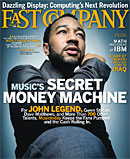
Last week, I had the grand opportunity to attend 'Backstage with John Legend,' a panel on music entrepreneurship and how artists are grabbing hold of their own careers in an age where intellectual property is hard to manage. The event was sponsored by FastCompany, a business-centric magazine that I thought was an upstart until I was told that the magazine had been around for 10 years but never really took off "thanks to mismanagement and poor business decisions."

At the end of the event, which was cordial, informal and altogether a relaxing good time (and educational, at that), I spoke with Dave Wolter, V.P. of A&R at Capitol Music Group and one of the night's five panelists that included Nathan Hubbard, CEO of Musictoday; Jorge Just, netroots manager for indie rockers OK Go; and Jason King, Artistic Director of the Clive Davis Department of Recorded Music in the Tisch School of the Arts at New York University (and my professor).

I spoke with Dave to simply say that I thought he was brave to be the music-label punching bag at an event where most of the panelists were shrugging off record companies entirely. I myself don't support the copyright-enforcing practices of his industry, but there are open-minded people who work at record labels, and I thought he spoke with an open mind instead of towing the industry line.

I also spoke with him about my own hard rock band, Dibble Edge, and asked him what he thought of the state of rock n' roll in modern music. He was reassuring - rock bands are still alive and thriving, despite the reduction of airtime on radio. He also reminded me to not count out MySpace, which many have said might become useless as a result of too many bands on the site.

Afterward, I spoke with FastCompany's Alex Pasquariello, who interviewed me and a classmate about the event. He promised both of us a mention in the blog post he was to write, and asked us basic questions that we both answered quite intelligently, given that we were taking a class on the same subject from one of the panelists.

The next morning, a huge post went up on FastCompany's site, but there was nary a mention of me or my classmate, neither the points we were trying to make. But he did, however, link (by request!) to the old OK Go video talked about during the event, but a new one not even mentioned that night, and used a good portion of the blog's word count to do so.

I figured, well, maybe Alex ran out of space. It's no big deal, even though he repeatedly promised. So I summed up what I spoke to Dave about in a few well-structured, linked sentences and posted it as a comment.

It never appeared.

FastCompany rejected my educational comment that augmented the very points he was making in his post.

But he didn't, however, reject a trolled comment that was a full-on pitch for someone else's business:

Hi. I am Javier, the founder of Trendirama.com, a community of online amateur writers. We write about the future of everything, and I would like to invite you guys to write an article on the Trendirama.com website, perhaps "The future of music in the US" or whatever you are passionate about? It is up to you, you choose the subject. You would get a link back when you link to your own article, if you wish. You can even re-use some of what you have here, in the last part of the article, "your view and comments". That would save you time and still be interesting for readers. Don’t underestimate this opportunity!
Public be warned: Alex Pasquariello is not a journalist, and FastCompany is not an independent magazine.

Neither one subscribes to basic writing style, or worse, ethics. Journalistically, FastCompany is no better than an in-flight magazine in receiving influence from the very people it covers.

According to their website:

Fast Company magazine is celebrating its 10th anniversary. Launched in November 1995 by Alan Webber and Bill Taylor, two former Harvard Business Review editors, the magazine was founded on a single premise: A global revolution was changing business, and business was changing the world. Fast Company set out to chronicle how a new breed of companies create and compete, to highlight new business practices, and to showcase the teams and individuals who are reinventing business. Today, the business world continues to change, and Fast Company continues to evolve as well.

And according to editor Mark Vamos:

Our mission is to find the creative workers and organizations that are building the future, and to present their stories in smart, compelling, beautiful, and useful ways. This mission is the core of the magazine's original DNA; it's the brilliant bit that differentiates us from all the other business magazines out there.

No, Mark. The difference is that the other business magazines hire business journalists, not journalist businessmen.

It's not the rejection of my comment that infuriates me. In the grand scheme of things, I don't really care. Really, it is the blatant courting by a magazine of its own subjects under the premise that what the magazine is practicing is journalism. If this is how a magazine operates its blog, how can I expect any better from the magazine proper?

Many established consumer magazines straddle the line between influence and influenced - fashion magazines especially - but advocacy is different than explicit ignorance. To the magazine's defense, I did read through the issue they had at hand, and the articles weren't bad. But who is writing them?

Nevertheless, the blog comment rejection came right after a panel event where the main topic was how artists can embrace their fans directly. Ha! How can a magazine gain new readers when it won't even post an educated, concise response from a mostly unaffiliated person who attended their invite-only event?

FastCompany, it's no surprise that even after a decade, no one has heard of you.