Showing posts with label magazines. Show all posts
Showing posts with label magazines. Show all posts
Wednesday, December 29, 2010

Thursday, September 10, 2009
A 30-year magazine veteran fights to keep storytelling relevant online

When's the last time you were told a great story online?
(Probably not in a long time.)
He's taking a magazine-style approach to interactive multimedia storytelling with a new venture, FLYPmedia.
I interviewed him for SmartPlanet, CBS' new site about smart technology, business, people and ideas.
Though FLYP is still in its infancy -- it reminds me of some of the work I did as a digital media student in journalism school -- Jim made some interesting insights as a 30-year veteran of magazine publishing moving toward the Web:
- "There are publications that are in print that don’t need to be in print and could be much more exciting in a digital frame."
- "Text is not the most the important element. It’s really a navigational device that leads people through the media."
- On producing interactive media: "It's like jazz. You all kind of stimulate each other. And it turns out better than anything you could have done yourself. When a video editor makes a great piece, it changes the story. When an animator does a great animation, it’s the same effect. It raises the game."
You can read the entire interview here.
Thursday, August 27, 2009
Why quality journalism costs a lot of money

We all love those long-form magazine articles, the meat-and-potatoes pieces that address the big issues.
When you're not in a rush, reading such a lengthy article -- it can be anywhere from 3,000 to 30,000 words, believe it or not -- can be a revelation.
"I didn't know that," you might say to yourself.
With such length, you might suspect that the article took a lot of time to produce. That's probably true.
What you might not know is how much it cost.
Gerald Marzorati, assistant managing editor at The New York Times and editor of The Times Magazine, recently answered reader questions about the inner workings of the magazine he produces.
Some of his answers might surprise you.
Addressing a question about the viability of long-form journalism in an era of rapidly narrowing attention spans, Marzorati explains that the price of a cover story for the Times magazine costs more than twice the price of the average American home:
Long-form journalism is expensive: The Magazine is publishing a 13,000-word piece on Sunday (it will be up online earlier) that we did in partnership with ProPublica, the independent, not-for-profit newsroom. One of ProPublica's editors and I did a back-of-the-envelop calculation yesterday of what the total cost of the piece actually was, figuring in several years of reporting and nearly a year of editing. Estimate: $400,000.
That piece, "The Deadly Choices at Memorial," is about the poor healthcare decisions that arose in the Hurricane Katrina crisis in Louisiana in 2006.
Jon Stahl highlights the important points of Marzorati's Q&A session:
- A cover story can cost several hundred thousand dollars;
- A cover story can take years to produce;
- Long-form journalism actually get more pageviews online than their shorter counterparts.
Most people probably have no idea of the costs of such articles. And the debate rages on -- even within the journalism community -- about whether articles of such length can be effective online.
But next time you read that article in a magazine -- followed by another one, and another one, until you get to the back cover -- think about the $5 it cost you on the newsstand.
Tuesday, August 11, 2009
Why I don't buy the argument for magazine cover photo retouching

One of the most interesting issues that has cropped up in recent years has been the debate over the ethics of airbrushing and retouching the artwork and photos that appear on the cover of a magazine.
I've been watching the debate with great anticipation, because I feel that it's a bit of a make-or-break issue for magazine publishing. I don't believe too much will change in the short-term, but I do believe it will establish more concrete boundaries as to what is and isn't acceptable in terms of modifying artwork.
Many magazines have come under fire for choosing to heavily modify their cover subjects, who are usually celebrities: Vogue, Glamour, Marie Claire, InStyle, Shape and even Self (irony of ironies!) have all been called out for a gratutious "we'll fix it in post [-production]" attitude.
Heading the effort is snarky women's blog Jezebel, whose "Photoshop of Horrors" series documents various magazine efforts to, well, hide the truth.
But how true should the truth be in a women's interest or fashion magazine?
The criticism grew so great for a recent Self cover depicting Kelly Clarkson as thinner than she really is -- a big deal, since part of Clarkson's image is the rags-to-riches theme that she's an average (and average-sized) girl who made it big based on that uniquely American potion of talent, merit and moxie -- that the magazine's editor-in-chief Lucy Danziger felt the need to address the issue in a blog post on the mag's web site.
Here are some highlights from her lengthy response:
Pictures are meant to tell a story, express a feeling, convey an emotion or capture a moment. Portraits like the one we take each month for the cover of SELF are not supposed to be unedited or a true-to-life snapshot.[...]Did we alter her appearance? Only to make her look her personal best. Did we publish an act of fiction? No.[...]This is art, creativity and collaboration. It's not, as in a news photograph, journalism. It is, however, meant to inspire women to want to be their best. That is the point.[...]
Kelly says she doesn't care what people think of her weight. So we say: That is the role model for the rest of us.[...]
Think about your photographs and what you want them to convey. And go ahead and be confident in every shot, in every moment. Because the truest beauty is the kind that comes from within.
If I may be so bold: does this not reek of excuses?
Allow me to address these points individually:
- Danziger first defends the edits on their face by declaring that Self isn't supposed to be "true-to-life." Somewhat hypocritical given the magazine's title, but the most legitimate point in defending this practice for magazines.
- But then she backtracks: We only did it to make her look "her personal best." That's impossible, because there's no way of reproducing a Photoshop job in real life. Her skin will not get unblemished. Her hips will not thin the way you've crafted them. Her teeth will not whiten so evenly. There's nothing personal about it.
- Worse, that reason allows that the magazine assumes responsibility for Clarkson's physical appearance. Last time I checked, she's a public figure -- meaning she (and her publicist) are the ones in control of how she appears in public. That's the cost of being famous. That's your primary job: representing yourself. If she's not at her "personal best" at the time of the shoot, is it really your job as a publisher to pick up the pieces? (And, if you're into back-door dealing, is it really fair for a publicist to withhold their client because she can't manage her own image?)
- By Self allowing image edits on Clarkson's figure under the excuse of Clarkson "looking her personal best," it allows that the magazine is now a part of Clarkson's public relations team. A thin line that all magazines straddle to be sure, but not something I'd readily admit to as an editor.
- Danziger then tries to compare the edits to journalism. No one's criticizing their work based on the accuracy guidelines for war photos from Iraq. To me, Danziger is defending her decision on the basis of an issue that has not been legitimately raised.
- Danziger then admits that Clarkson doesn't care, and uses that as an excuse to alter the photo. Again, hypocritical -- especially in light of the "personal best" reason (so we're kissing up to her!) and the following one, below.
- Danziger finishes with a dashed off, clichéd line about how "true beauty" comes "from within." Besides the fact that the phrase rings empty, it still flies in the face of the effort, time and budget spent to modify Clarkson's photograph.
Jezebel's criticism is based in the implication of an ethical boundary that has been crossed: women should not be fooled into thinking or idolizing something that is not possible in the physical world, and anything less than 99% truth is ethically reprehensible.
But it's not the ethical issue of representing women on covers for readers to look up to that bothers me the most. What's really aggravating is that no publishing professional has owned up to the real reason: a better-looking magazine sells more on the newsstand.
(And the unspoken inference: rightly or wrongly, the majority of people find thinner women more attractive. And "more attractive" is always a way to sell more magazines.)
Why is it so hard to just respond to criticism that way? If the decision is made not on the basis of ethics or representation or idealistic idolatry among readership, why not defend it on that ground?
(Certainly no one's holding Danziger's feet to the flames for mere color-correction.)
For sure, it's unfair that Danziger is being singled out in this post (and others) for her response. Self is hardly the worst offender of this practice. But her attempt to defend herself just fell flat to me.
The calling card of most general interest magazines is not their hard-hitting articles or their ethical rigidity. It's their ability to entertain. They are vehicles for leisure, and they convey that spirit through layout and design.
A magazine without that isn't a magazine at all, the way I see it. And at the end of the day, magazine publishing is a business. Period.
So why defend it any other way?
Update: Looks like Self entertainment assistant Ashley Mateo gets it. Amid meaningless fluff, she writes:
"Magazines don't hide the fact that they're always trying to sell issues--and to sell copies, you need to appeal to readers with the best writing and the best images possible."
Perhaps the corner office is too insulating?
Update 2: Jezebel's Margaret posted her own analysis.
Wednesday, April 15, 2009
The problem with magazines à la carte
 When Time Inc. first announced its plans to offer its magazine content à la carte, called "Mine," my first thought was that it was catching up with the times. After all, isn't that what people do on the Web? Pull what they deem the best from several different (and sometimes competing) publications?
But instead of posting, I thought I'd sit on the idea for awhile and let it stew on the backburner of my brain. It's never wise to rail against or praise a business model in a knee-jerk kind of way -- these things are often more complicated then they appear, and business models are chock full of competing interests.
Now that I've had some time to think about it, it occurs to me that with "Mine," certain magazine staff are getting the short end of the stick.
First, let me explain how Time's offering works. The consumer gets to pick five titles from the Time Inc. stable -- the largest in the business -- and soon that reader gets tailored issues pulling content (or stories, in the printed parlance) that matches his or her interests.
Interested in the executive life? You'll probably get material from Time, Money, Golf, Food & Wine and Travel + Leisure. If you're more a fashionable jet-setter, perhaps a combination of Real Simple, InStyle, Travel + Leisure, Time and Golf.
You get the idea.
Curiously, some titles that would match others are left out of the mix: Fortune. Coastal Living. People. Essence. Entertainment Weekly. Wallpaper*. Cooking Light. This Old House. Et cetera.
I suspect that decision is threefold: to avoid pillaging the company's entire portfolio; to keep subscribers of several magazines (it's likely that a Money subscriber already also gets Fortune; a similar possibility exists for Travel + Leisure and Coastal Living) subscribing to distinct publications; and to make sure that advertiser dollars are coming in without them trying to shortchange established rates for individual publications.
Whatever the reason, though, I don't like it. It seems to be a massive convenience for the user, but it really takes away from the point of a magazine. And that's what gives me pause.
Magazines are powerful because they are packages. Whereas newspapers are intended to deliver information quickly, magazines are intended to be leisurely read, analytical (or, at the very least, big picture) and a form of entertainment. They are less an information vehicle as a leisure activity, so much as information can be entertainment.
A big part of that "package" is the design, layout and story selection of the magazine. A big part of editors' (and publishers') jobs is to make sure that the magazine flows from cover to cover. It's not a piecemeal exercise. Magazines are, by their nature, a curated collection.
So while magazines a la carte seems appropriate in a world of RSS feeds and customizable content delivery, it's really at odds with the very nature of a magazine. It turns magazine content into, well, content -- separating it from the infrastructure that a magazine issue provides. And that's a problem for the editorial and business departments alike.
I've previously criticized magazines for not jumping on the Web sooner and in a better fashion. My argument was that they were missing a great branding opportunity, a great chance to extend the brand with far less overhead than a spinoff publication (Vogue Living, I'm looking at you). There's no reasonable limit to how much content can be produced on the Web. And the price of ink and paper doesn't even factor into it.
Of course, the challenge of the Web is in reproducing the perfected magazine form in a new medium. So when I look at this a la carte service -- which eschews planning altogether, reducing magazine content to words -- I cringe.
And that's exactly what Time Inc.'s "Mine" is -- unplanned. It's offered to you in printed form or via online delivery to your inbox. I haven't had the pleasure of seeing either form (Time Inc. doesn't offer you a preview without you handing over all of your vitals), but I can't see it being a successful publication in its own right. The content is generally disconnected from itself, it may overlap and it, in all likelihood, has little flow to it. It's a very utilitarian approach, which is at odds with magazines as entertainment. They're simply not necessary to live. They're just nice to have.
The "Mine" endeavor smacks of marketing, and very little of editorial. There's nothing wrong with that on the face of it, but if the company wants to effectively create a new publication, it will need oversight. And it takes at least half a traditional magazine staff just to curate previously-published content in a way that it could fit together. Even then, the fit isn't perfect.
Above all, new endeavors must pass a simple litmus test: does it solve a problem? (Or does it make enough money that it doesn't matter?) I see neither of these options. By offering "Mine," Time Inc. is backhandedly shunning the work its editors and art directors for the (likely freelance) writers. It doesn't solve the magazines-on-the-Web problem; it doesn't solve the declining print circulation (and thus ad revenue/pages) problem.
So what's a publishing house to do? Well, in a global economic downturn like this, it's to make sure its portfolio (and thus its staff) is lean and mean, both in printed and digital forms. "Mine" just strikes me as fatty excess, even though it appears to be a cost-saving way to reuse content.
With such limited appeal, exposure and choice on the part of the consumer, I doubt any "magazines à la carte" solution has the legs to stand the test of time. With "Mine," you can have it.
Friday, February 13, 2009
Tina Brown and the fight to save journalism

If you're a writer, get out of your comfort zone.
If you're an editor, surround yourself with writers.
And if you're starting an online publication, do so with conviction. It will work.
Eventually.
Brown's Daily Beast -- for which at least one friend of mine writes -- has been in the spotlight since its launch last fall. A new media venture by an old-media person, if you will. An online pubication brave enough to not accept (interns aside) free work. A digital venture (questionably) backed by IAC's Barry Diller.
But Brown revealed last night that the venture is very much her vehicle for figuring out how publishing can survive in a "free," online-only environment. Correction: not just survive, but thrive. And in this current state of media flux, it's exciting to me to know that someone is pursuing something with conviction, and not floundering about trying to stay afloat.
Highlights which I'd like to pass along to you, readers:
- Deploying narrative journalism on the web successfully is Brown's greatest challenge.
- The Daily Beast continues Brown's tradition of high/low coverage (or "class and trash," as I like to call it.)
- Some of her best writers didn't start as writers at all. Some of her best writers were passionate about topics they weren't writing about for a living. It was Brown's challenge -- and naturally, to her benefit -- to correct this. Example: Dominick Dunne, whom she told to keep a diary; Jeffrey Toobin, whom she simply gave enough time to develop his own (less-than-legalese) voice.
- Editors must "make their world writers," and surround themselves with them. They are immensely creative people, she said, and you must know their strengths and weaknesses and, of course, always have talent on hand.
- A big area for development is in-depth, feature-length business journalism. Not closing-bell coverage, but CEO profiles and such things. "Capture characters," she said.
- The Daily Beast is doing what newsweeklies should be doing -- analysis and less breaking news coverage -- in the smart and intellectual way that Time, Newsweek and U.S. News & World Report are struggling to transition to at the moment. But, with the added benefit of linking off to the best of the web's stories.
- The advantage of analysis: "People are gadflies, but they're also obsessives." So while hopping on the breaking news train is fine, people are still drawn to long-form, in-depth analysis telling them something they didn't already know.
- "A good editor (at least, one in the vein of Tina Brown -- Ed.) likes a strong staff around them." Strong as in personality: "I have a terrible weakness for irritants."
- Working online is actually less stressful/anxiety-ridden than print, because there are much fewer moments when someone's piece is cut because of limited space. "It's more physically grueling, but it's not as stressful in terms of disappointing people."
- "It's so fashionable to trash the press all the time."
- On the theory behind paying writers and investing in them: "You have to invest in people." Unlike her big-budget Conde Nast days, Brown can't hire writers on contract anymore, so the web environment makes it harder to develop people and give them a financial safety net at the same time. On the other hand, limitless space is helpful in that regard.
- 2009 is the year of the freelancer. "The Gig Economy," she called it.
- The Daily Beast has started to solicit advertisers, which will be its main revenue stream. Ads will appear in the spring.
- On outsourcing journalism: "I think it's preposterous."
Before attending, I knew little of Brown. I knew she and Arianna Huffington (The Huffington Post) were often cited as brash new editors-in-chief/publishers in the new media/online journalism world. I knew Brown had a fantastic pedigree. I knew she was British.
But that's about it, honestly. So I was surprised when I heard these wise words come from someone who has been in the magazine business so long -- and who seemingly got into online publishing by necessity.
Brown spoke honestly and thoughtfully -- she wasn't there to publicize The Daily Beast, and didn't really reference it unless it was referred to in a question she was asked.
In listening to her opinions and advice, I came to respect her for this reason: she had a clear view of what she wanted and where she wanted it. An entrepreneur, she was pursuing publishing online, she wanted talented writers, she didn't want to cut corners nor spend funds happily.
Personally, I don't like everything about The Daily Beast. (For one, I think its design, while adventurous, is a little hard to digest.). But I do now understand why things are the way they are on the site, and the thinking behind those decisions.
An old professor of mine likes to use the phrase, "Acts of commission, rather than acts of omission," when referencing online work. I can see that in operation at The Daily Beast.
Brown's vision may not be an ironclad business model, but it was her conviction that struck me. At a time when so many journalists -- newspapermen and women, freelance writers, editors, publishers, etc. -- are running to the next thing (blogs! Facebook! Twitter!) or just simply lamenting their own downfall (layoffs! cut pages! no ads!), I found it refreshing -- exciting, really -- to hear such a clear voice at such a cloudy time in journalism.
Wednesday, January 14, 2009
Ad pages in magazines dropped 11.7% in 2008
 Of the more than 230 magazines tracked by the Publishers Information Bureau, only 42 -- or about 18% -- saw ad pages increase for the year, according to figures released by the Publishers Information Bureau via Folio's Jason Fell.
Of the more than 230 magazines tracked by PIB, only 42—or about 18 percent—saw ad pages increase for the year. In other words, it was the biggest dropoff since 2000, the earliest year comparative PIB numbers are available.
Each of the top 12 advertising categories declined in 2008. Hardest hit? Automotive, with titles such as Hot Rod and Automobile, which saw ad pages fall 24.3 percent and revenues decline 20.5 percent to $1.67 billion.
Next up were business magazines. SmartMoney, owned jointly by Hearst and Dow Jones, saw the most severe decline, with ad pages falling 29.7 percent for the year. Mansueto Ventures’ Fast Company was the lone holdout, which posted a 23.9 percent gain in pages. (It should be noted that FastCompany effectively shuttered their online unit and pushed its resources exclusively toward the printed product. -Ed.)
Newsweeklies were next. U.S. News & World Report, which will become a monthly, saw ad pages plummet 32.4 percent for the year. The Week was one of two magazines that posted flat ad page results for the year.
Finally, music magazines. Fell writes that Blender is on "life support" and saw ad pages fall 30.6 percent for 2008. Rolling Stone, which shrunk its signature-sized magazine this year, wasn't far behind, with ad pages declining 23.8 percent.
See if you can pick your favorite title out of this table:

So, who wants to be a magazine editor? Anyone? Anyone?
UPDATE: A great related article by Salon's Rebecca Traister. Here's a good bit from it:
Despite decades of premature bell-tolling about the death of print, turn-of-the-21st-century magazines were, in many ways, plump geese, fattened on big advertising budgets, a seemingly limitless market and an expanding class of consumers eager to spend money on expensive things (whether they could afford them or not). Americans wanted to eat well, dress fine and live lavishly, and that was good for food and shelter and fashion magazines. Americans wanted to wallow in celebrity gossip, and a passel of glossy weeklies was born, delivering Hollywood gossip in photo-larded installments. The pesky divide between editorial and advertising melted with the development of magalogs, publications like Lucky and Domino devoted entirely to introducing readers to stuff they might want to buy.Good stuff.
Monday, December 15, 2008
Why You're Losing Your Magazine Job

Magazine behemoths such as Time Inc. and Conde Nast (and Hearst, more quietly) have been slashing staffers and budgets in large numbers recently.
The reason? The economic downtown.
Or is it?
AllThingsD's Peter Kafka notes in a new post that publishing houses are also shedding ad dollars left and right, indicated in this graph from MediaPost, which is based off ad sales data from magazine trade publisher Media Industry Newsletter:

The problem? It's not just the steep decline of ad pages due to the recession -- no, it's because magazines were running flat even before the decline, thanks to a fundamental shift of ad dollars away from print and toward the Web.
In other words, magazines were barely getting by as it was, and an economic throttling just sunk an already barely-seaworthy vessel.
Remember two and a half years ago when I asked why newspapers were beating glossies to the punch on the Web? In that article, I lamented the ill-preparedness of magazine publishers in their Web dealings: flashy but poor "destination" sites with poor usability and poor brand representation that served only as subscription centers, rather than as logical extensions of the brand with original content (CondeNet, I'm looking at you).
Now it looks like magazine companies are finally paying the price for their (expensive but ineffective) dabbling.
Or, in other words: that's what you get when you only have one full-time staffer ("Web editor") for a magazine's entire online presence.
So should magazine editors contemplate an online-only career? Maybe -- it's not clear, because the magazine as a vehicle for content still has the tangible value: the bring-it-into-the-bathroom factor (a factor not as strong as it used to be).
Logically, then, I expect magazines to go on a decline, but not bottom out. Unlike newspapers, who peddle breaking content (strictly, "news"), magazines peddle much more design and commentary. So while daily newspapers will gravitate toward analysis to keep their printed product afloat, magazines already have a safety net in the basic nature of their product.
So what about magazine jobs?
It still doesn't look good. Kafka writes:
"It's unclear how many jobs the Web is going to offer, since digital content is worth so much less than its analog counterpart, at least in the eyes of advertisers."
But that's quickly changing, since there are so many more eyeballs on the Web. As circulation numbers steadily decline, advertisers will gradually place more value in the Web, and publications would be wise to encourage that. After all, there are no printing costs (just hosting), and overhead is so much lower thanks to almost-free distribution.
There are even rumors confirming such things: For example, the dissolution of men.style.com (for which I've previously expressed my disgust) and the launch of distinct sites for GQ and Details.
But that still doesn't replace the original magazine, and in that way, the website will forever be an extension of the original (printed) brand.
Still, I blame magazine publishers for not being prescient enough. For example, have you seen the website for T, The New York Times Magazine? It's not perfect by any means, but it's an innovative way to make a website stylistically mirror the printed publication. There are several highfalutin publications that see T as a competitor. Why not also one on the web?
So where does that leave the magazine editor?
Well, start polishing that resume and brushing up on your HTML -- if you don't know what CMS stands for, you're just as much in trouble as the editorial assistant who hasn't heard of Adobe InDesign.
Thursday, October 30, 2008
Conde Nast's Men's Vogue and Portfolio Slashed. Here's why.
 Condé Nast has announced that it will reduce the number of issues that it publishes of two magazines, embattled business glossy Portfolio and the never-quite-got-off-the-ground Men’s Vogue, and will cut budgets across the company by 5 percent.
Let the belt-tightening begin, magazine lovers.
Portfolio will be published just 10 times a year, instead of 12, and Men’s Vogue will come out twice a year instead of 10 times, much like it did for the first two years of its publication.
While Portfolio has withstood its share of high-profile changes, Men's Vogue has flown under the radar, an oft-forgotten sibling to the fashion flagship Vogue. The New York Observer's got the dirt:
"It'll be a small, small, small version of what it is," said a 4 Times Square source. "And the small version will exist for nothing more than for Anna to save face."Frighteningly, some of Portfolio’s online operations, including advertising sales, will be folded into those of Wired magazine, the popular tech glossy bought by Conde Nast several years ago.
I don't know much about Portfolio besides what's in the headlines. But it's my opinion that Men's Vogue never quite got off the ground for several reasons:
1) It had an imagined audience that couldn't be matched in reality (average income for MV readers was somewhere in the ballpark of $180,000 a year, way, way above that of Vanity Fair, Vogue and GQ).
2) It was somewhat irrelevant. GQ succeeds because it serves a wide audience. Men's Vogue was a niche publication that was so pricey, content-wise, that it was aspirational for its 180K/year audience. Would you spend $5 on Men's Vogue at the newsstand? Or would you bypass it for one of the other ones? And as for subscriptions: there just aren't that many young, rich people in the world. You can't have both.
3) Ad dollars never caught up. Sure, its readers had a high income, but there weren't many of them. Several of this year's issues were thin, thin, thin. We're talking New Yorker thin.
4) Staff turnover. When the staff keeps changing, the creative director leaves, the handful of actual editors (not fashion or art dept. people) keeps turning over, how do you expect to have a coherent voice? This was a new magazine. The voice wasn't quite there yet to pass on.
4) It was boring. I could tell you the editorial guide to Men's Vogue right here:
Straight-and-narrow famous male celebrity on cover (Denzel, Clooney, you know the type! No one you wouldn't bring home to Mom). A story about a new jet, yacht, or expensive status toy. A Blackbook story about something illicit in a James Bond-kinda way: gambling or espionage. A layout about ties or watches or bespoke shoes. A profile about a fashion designer or craftsman of some kind (usually in Europe, preferably Italy). A highfalutin review of a book or movie or art gallery show. A product breakdown of pricey imported aftershaves. A fawning one-page take on who showed up at last month's biggest, swankiest soirees. A preview of an up-and-coming young female actress, author or musician (any creative type will do). Main cover feature, eight pages; follow with smaller features that expand on the topics in the FOB. A major art dealer. A power broker. A brand-new car produced in a limited number. A high-class story about a low-class Western European pasttime, like rugby or hurling. A vineyard in Australia. Finish it out with a sobering story about Iraq or some other war, which no one will read, and then book-end that with a photo spread about pea coats or leather bags or some other item with cachet. Last page has an interesting snooty item for auction at Christie's or Sotheby's, then scene. Scatter some photos by Annie Liebovitz and make sure the bylines are the best of the best. Throw in a couple of ads for $30,000 watches, Ralph Lauren, Bottega Veneta and Prada and there you have it.
Sound interesting? Kinda like Details, which is pretty much like GQ, right? Exactly the problem. At first, it sounds like a packaged dream deal for ad sales, but then you realize you're basically selling the same magazine three times over. Hey, at least Men's Vogue looks like it has more personality than Details (it doesn't, really).
The three CN men's magazines do differ, of course. But when the readership wanes as well, it's hard not to consider folding one's coverage into another title.
That's what I think. Of course, I can only guess at Men's Vogue. But I know both publications had high-class, ultra-talented people working there.
I think Conde Nast is one of the finest media companies in the world. And they produce some of the smartest magazines in their class. But I also believe that opportunities and resources can be squandered.
It's kind of like the New York Yankees -- you can have the highest payroll and the most star-studded roster in baseball, but that doesn't mean you're going to make the playoffs.
(Disclaimer: I used to work, in a temporary fashion, at Men's Vogue.)
Tuesday, October 28, 2008
Time Inc., #1 Magazine Co., To Lay Off 600 Employees
 A sad day at the biggest magazine house in the world.
Time Inc. has announced job cuts of 6 percent, or more than 600 positions, and "a reorganization that could radically alter the culture at the venerable publishing house," according to the New York Times. The company has 7,000 employees in the U.S. and 10,200 globally.
The breakdown:
- News came via a memorandum Tuesday evening from Ann S. Moore, Time Inc.’s chairman and chief executive.
- The layoffs will begin in about two weeks.
- No magazines are scheduled to close, but some are likely to be severely cut back.
Time's 24 magazines in the U.S. and their websites will be organized into three divisions: "News," which will include Fortune, Money, Time and Sports Illustrated; "Lifestyle," which include Real Simple, Cottage Living, Coastal Living and Southern Living, among others; and "Style and Entertainment," which includes People, InStyle and Entertainment Weekly.
"Power within Time Inc., which through many mergers over the decades became the modern Time Warner, has long been diffuse, with individual publishers and editors essentially running their own shows. That distinct culture is coming to an end."
Sad day.
Tuesday, August 05, 2008
Everything You Know About Magazine Covers Is Wrong.
 ...at least that's what seasoned publishing exec Steve Blacker says, who wrote a fabulous and acute study of magazine covers that I pulled from MinOnline.
There's been a nice healthy amount of magazine-focused stories lately, and this is a great lesson for magazine editors-to-be and really, all creative types, editorial or visual.
Some highlights:
1. The more time spent working, planning, and strategizing on a cover, the better it will be. Too many editors put their covers together at the last moment. Cosmopolitan editor-in-chief Kate White, who will celebrate her 10th anniversary in August, plans her covers a year in advance.
4. The cover image. You should be constantly testing "out of the box": think the Esquire legend George Lois; think cover images. To test the "same old" will just replicate the "same old" in sales. If something seems too "out there," then do an "in market" test in 30% of the country.
6. Are you overwhelming the buyer with too many cover lines? Research has shown that crowded covers are often stated as the reason an impulse buyer did not purchase a current issue.
8. Is your editor-in-chief the best person to be orchestrating the creation of your cover? Many top editors are not top cover creators, nor cover-line writers. Why not bring in a George Lois, Milton Glaser, or Steve Frankfurt? Have them produce some alternate covers and test them in market.
The bottom line? Covers are supposed to sell the magazine. So why aren't we working harder on them?
And an even better question: Why aren't we considering the same strategies for magazine websites?
Wednesday, July 30, 2008
Five Reasons Why Women's Magazine Sales Are Plummeting
 While not on my daily reading list, Jezebel is always acute with their criticism of the women's and fashion magazine industry. Today, senior editor Dodai Stewart summed the whole thing up with a list of why circulation is down, down, down:
1. The covers suck.
If you love fashion, why would you pick up a magazine that had a Photoshopped roboGwyneth on it? Or an animalistic-looking basketball player? Or Sarah Jessica Parker wedged between a decapitated man's legs? French Vogue's covers are daring and provocative; American Vogue relies on Kate Bosworth's "superstar style." YAWN.2. Photoshop is out of hand.
Art directors rendered Drew Barrymore and Tina Fey almost unrecognizable. ScarJo's waist was whittled. Not even "healthy" magazines like Self and Fitness are immune. Maybe readers are sick of the artifice?3. Expensive Shit.
Even if you adore the fall collections and think of Galliano as God, you probably can't afford a $13,000 dress. So when you have to look at said $13,000 dress posed in the middle of a desert like it ain't no thing, you can get miffed. No? How about a $270 Bible? Or a $246 Louis Vuitton headband?4. "News" you can't use.
Once you get past the cover and expensive shit, some mags are filled with mind-numbing, trite or just plain evil content. The illustrated "How To Take A Shower" piece in Allure comes to mind. As does the quote from Vera Wang in Vogue: "The armpit is nasty, nasty. Even young girls can have this problem."5. The Internet.
When in doubt, blame this Web 2.0 thing everyone's talking about!
I agree on all counts, in varying degrees. While many of these are exactly the reasons people DO read these magazines -- after all, readers aren't stupid -- I think the lack of inventiveness on the whole is really starting to bring them down.
Just the other day I was remarking to someone how good Harper's Bazaar looked compared to Vogue, while musing that Harper's has always had trouble keeping up with Vogue in ad pages. Vogue has been so...stale lately (the Kate Moss scoop on Page Six Magazine as an exception), visually as well as textually. Same goes for many of the others.
They just look...tired. Uninspired. And many of them read that way, too.
In fact, the most surprising thing I've seen lately is the reinvented O, The Oprah Magazine covers...all the white space is shocking when compared to the coverline-heavy, big image, poorly photographed (Annie Liebovitz and Mario Testino or not), manufactured covers that surround it on the newsstand.
It's like staring at a production line.
One more point: the value of Dodai's Jezebel list is in fact the comments that follow it. Sometimes Jezebel comments get overly sarcastic, but I think there's a lot of value in what's being said below. For example:
I would say prices. The cheapest magazine I could find was $3.50. I do feel bad for the women journalists that work for them. I would hate to see people laid off because of this. I think people ignore that some women magazines do have good articles in them about some amazing women. -tranquilmademoiselle
Indeed.
Monday, July 28, 2008
Diary Of An Unemployed Young Journalist: An Open Letter To Entry-Level Journalism Jobs Everywhere
 Dear entry-level jobs ("ELJ"),
Where have you been?
I've been looking everywhere, virtually since the day I got my bachelor's degree in journalism from a reputable university. But I haven't been able to find you -- not on my university jobs database, not on New York Times Company Careers, not on Dow Jones Careers, nor Hearst Publications, Conde Nast, Time Inc., Rodale, Bauer, Hachette, Bonnier, Village Voice Media, News Corp., New York Observer, Manhattan Media, Gawker Media, CBS, NBC, ABC, Folio Jobs, Poynter.org, Mediabistro Jobs, Ed2010 WhisperJobs, Monster, Careerbuilder -- even the smaller companies of publications like New York, Interview, Radar and so forth.
That's newspapers, magazines, broadcast and online.
I feel like I've looked everywhere for you, ELJ. But I can't find you.
I've certainly tried my best to catch your attention. I thought my bachelor's journalism degree in New York wasn't enough, so I went to the top journalism school in the country and got a master's degree in New York, too.
You know, they don't really make journalism degrees any higher than that, ELJ.
Along the way, I interned at one of the Top 10 newspapers in the U.S. and three national monthly magazines, all under big companies (some might call them the "Big 3" of publishing). Everybody I know said internships were the big way in, so I went and did five.
I'm pretty lucky to have gone to school in this town. Wouldn't you say, ELJ?
But where are you when I need you?
Since I'm not receiving any handouts from dear old Mom and Dad -- especially with regard to the price of grad school and the incredible price of rent in this city, the biggest and most expensive in the U.S. -- I've even done some freelancing, some for notable publications in this town. It used to be a fun side gig, but when I'm depending on that $400 check that comes every couple of months, that's no good, right?
After all, every young journalist needs clips, right?
And hey -- my writing made the cover of a small national monthly magazine three times this year -- did you see, ELJ?
If you did, I wish I knew. Because I can't seem to find you.
Be well-rounded, they said. Be web-savvy, they said. Be flexible, be cheery, and most of all, be professional. Everyone loves a hard worker.
Well, I practiced my hard news stories. Inverted pyramid, soundbite quotes and all that. I've never even had a correction run for one of my pieces.
Then I edited stories by other people. I tried my hand at science journalism, technology journalism, business journalism, arts and entertainment, fashion -- even religion reporting. I challenged myself to see if I could cover everything equally as well, be it short news pieces, briefs, or full-on Rolling Stone-style profile features.
I researched. I fact-checked. I copy edited. I even tried blogging, both for the snarky and staid.
Then I went and learned Photoshop and InDesign and Illustrator and Dreamweaver. I learned how to shoot and edit video and photos. I practiced how to make webpages -- I even set one up for myself. And -- get this -- I learned Adobe Flash this year. How cool is that?
I trained my eye on my resume -- cleaned it up, made it classy, cut the junk. I practiced writing cover letters. I networked -- introduced myself to people, showed them my website, LinkedIn with them.
If you Google me these days, it's a trove of love letters to you, ELJ.
Then, when the time came to work in this big town, center of technology and media and finance and basically everything, I applied like a madman. I started slow, to test the waters, but when time started passing, I quickened the pace.
Editorial assistant jobs, assistant editor jobs, news assistant jobs, beat reporter jobs, online editor jobs, multimedia producer jobs, administrative assistant jobs -- I went after them all. And why not? Everyone told me it'd be a lot easier to find you if I had more feathers in my cap.
You must be allergic to feathers, though, ELJ. I can't seem to find you.
I asked my friends for openings at their companies, only to hear that they might be fired soon because of the economy. I asked my mentors for openings at their companies, but most couldn't find anything. Romenesko keeps saying all the positions for senior staffers were being cut in lieu of openings for young upstarts like me. The new generation of do-it-all journalists. But every time I search for jobs, how come the only ones open are for "senior editor" or "deputy page one editor"?
And gee whiz, there are a lot of internships available. But I think five is where I draw the line, ELJ.
Besides that, I just see freelance gigs that guarantee a lot of wasted time for little reward, or a lot of jobs that require three years of experience. But see, that's what I'm looking for.
ELJ, I'm looking for you.
I even bought a snazzy navy suit for the occasion. Your receptionist, "informational interview," said I look nice and I'm superbly qualified, but she said she can't find you, either.
Must be the economy. Must be the time of year. But let me tell you -- if there's one thing I've got, ELJ, it's information. Now I just need to find you.
I'm getting worried now. Rent's due soon, and $900 doesn't sound "stabilized" when you're not making anything. Who am I kidding -- it sounds like a lot to you too, doesn't it, ELJ?
Everyone says I should move out of the city. But why? I made so many professional connections here. And if everyone's moving out, and those jobs elsewhere are disappearing, who's left anyway?
I'm worried, ELJ. I can't find you. Where are you?
Sincerely,
An Unemployed Young Journalist
Monday, July 21, 2008
NYT Woe-Is-Me: Magazine Interns Denied Summer Fridays, Real News
 The New York Times hates puppies.
That's because the Fashion & Style section made a poor editorial decision to run a story that covered (rather, created) news that New York City's highfalutin fashion and women's magazine interns can't bear to stay home from the Hamptons and work a full Friday (rather than get "Summer Fridays" and depart at 2 p.m.).
Are you kidding me?
On July 20, 2008, in an article titled, "At Magazine Offices, Another Summer of Jitney No-Shows," by former WSJ staffer Lauren Lipton, the twenty-something interns of Glamour, Vogue, Interview, Harper's Bazaar -- hell, virtually every in-demand magazine by Conde Nast, Hearst, Time Inc., HFMUS and Meredith -- lament staying and working on Friday while everyone else in the entire city hops on the Jitney to the Hamptons.
"Woe!" a rail-thin intern shouts as her fingers get sticky paste all over them as she puts the final touches on "the book" for a certain top editor. "Lament!" another shouts, as she gets tangled in a webbed Dolce and Gabbana concoction, tripping in her last-season Louboutins and accidentally stretching the stitches on her Chanel skirt. Wherever shall they eat dinner, with everyone having left for the Hamptons?
God, it must be terrible to work at a magazine.
OK, now let's dial down the sarcasm and approach this moderately. The heart of this article -- which I urge you to read -- is that ad pages are down in a tough economy, and the editorial side (and their workdays) is much more at the mercy of the business and advertising side. Which is a legitimate concern, since that inadvertently dictates the quality of the product as a whole (and the quality-of-life factor inside the offices).
My problem with the article, sadly, is three-fold: 1) somehow, the (unpaid or very low-paid) interns are given the spotlight; 2) the interns' work lives are compared to that of the editors-in-chief of the publications; and 3) we, as readers, are supposed to feel sad that no one gets an early Friday.
Well, I've got news for you, New York Times: the whole thing is ridiculous. Why?
First (and foremost): We should not be sad that someone who has a coveted position at a popular publication can't get Summer Fridays when a increasing amount of people -- including some very savvy professionals who want to work in publishing -- can't find work, even in the world's publishing mecca, New York City. Much less all the poor people who couldn't leave the city if they tried.
Second: The real focus of this article should be the staffers with salaries, who can't make any more if they stay until midnight every night (which they already do near close). If the low-paid interns are complaining about extra hours, they ought to consider the extra money they can contribute to their rent, the most expensive in the U.S. (and I'd know -Ed.). If they're unpaid interns, perhaps the article should be focusing on how unpaid interns are being taken advantage of, working endless hours with no job promises in sight. The editors-in-chief might have to start taking page proofs with them on the airplane, but most of their interns can't even afford to board the plane in the first place.
Third: If any intern, anywhere, plans on spending their weekends in the Hamptons, they should not be considered "interns" by any stretch of the imagination. And if I'm then supposed to feel sorry that they can't leave until 5 (okay, 6 for magazines) on Friday, trust me, these tear ducts are dry.
Even the artwork for the story is misleading (shown above). No one works in darkness like that at a magazine -- there are flourescent lights lining the office!
To boot, the article signs off with a weak disclaimer -- "Well, sure, people who work at magazines get perks, like chocolate" -- and then drives the ridiculous stake home with a quote from a Conde Nast intern who supposedly envies other interns. Which is ridiculous, because no matter how much someone grows frustrated working at 4 Times Square, they will never, ever deny that the spot is prestigious and coveted.
"Those of us in the magazine world are here past dinner, and then by the time we leave are far too tired to go out drinking. I guess it’s a good thing. It’s an honor that they take us seriously enough to work us this hard."
No, honey -- it's not really a negative that you're too tired to get trashed, and trust me, it's a gamble whether your editors take you "seriously" enough to work you that hard. Many do just because they can.
The whole thing is repulsive. And how do I know?
Because I've been there.
I have much respect and reverence for journalism and the magazine business. I find it thrilling work. But let's call a spade a spade. This article doesn't tell me anything necessary or even interesting as a reader. My time and money appear to be wasted.
Which means somewhere, a puppy is going without dinner.
Thursday, July 17, 2008
What Magazine Publishers Don't Want You To Know
 Unbelievable investigative report by Craig Malisow of the Houston Press:
In the eight months the Press investigated door-to-door magazine sales across the country, the industry has seen at least three murders, one rape, two attempted rapes, one stabbing, one attempted murder, one vehicle fatality and one attempted abduction of a 13-year-old girl.
Interviews with former agents reveal a constant party atmosphere where agents have easy access — often thanks to their managers — to drugs. The agents come primarily from two populations: reprobates who need to leave wherever they are fast, and vulnerable kids from unstable families who believe that hopping into a van full of strangers is better than what awaits them at home.
Read more of What Mainstream Publishers Don't Want You to Know About Door-to-Door Magazine Sales: That kid at your door with a magazine order form will tell you a story -- part sad, part hopeful. The truth will be infinitely worse than you can imagine.
Tuesday, July 08, 2008
How ESPN's Fawning Sports Coverage Makes Sports Illustrated Look Like The Economist
 Pulled straight from my RSS feed a few minutes ago:
Report: Favre sends text message to Packers GM
Now I know the Brett Favre-Packers saga has a lot of people's minds and hearts in it -- plus, football-wise, it's a golden series of stories -- but this is ridiculous.
And no, it's not just a copy editor's headline flub, either. Here's the third graf of the story:
But WTMJ-TV in Milwaukee reported Monday that Favre sent a text message to Packers GM Ted Thompson on Saturday -- and that Thompson's reply was that he is on vacation and the two men will have to talk later.
Seriously, guys, just because you have to cover the story closely until there's an outcome doesn't mean I need to read every second.
Saturday, February 23, 2008
Why Aren't Magazines Themselves On The Web? A Letter To Publishers.
 Every time I visit a magazine's website, I'm disappointed.
 Why?
Because I don't get the same experience that I appreciate getting as a reader of the print publication.
Normally, that's fine. The success of a magazine's website isn't to emulate the print publication. It can't, too, since it's generally accepted that magazines can't be as easily replaced as newspapers in an online format.
So why am I disappointed, then?
Because most magazines' websites are cluttered. Obscenely so. Ads scream at you "above the fold" and keep on screaming until the fifth or sixth scroll down. Featured articles are rarely featured. Less-than-quality content is given the same weight as the cover story. And for God's sake, I don't even know where I am on this damn website.
Get what I'm saying? Magazine websites don't feature their content the way they do in the printed format. And that is what I think makes a magazine so enjoyable to read in the first place.
I understand that most big-time publishers haven't put "enough resources" (as their web editors might say under their collective breath) toward the development of the online platform. They pay for a template, a content management system, and a couple peoples' salaries to keep the thing going. The focus is still on the moneymaker -- the printed magazine. And I get that.
But they're hurting themselves so very much.
A website is the online face of the magazine. For most, it looks as if that face has way, way too much makeup. The problem with this is, despite a lack of significant ad revenue, there are on average five times as many readers online as there are for the printed publication. Five times as many eyeballs -- which means a vast majority who don't subscribe to the site (there is, on average, about 10-20 percent overlap with the printed publication). And what do these readers have to greet them?
An information overload, a vague identity and no reason to subscribe. When online subscriptions cost the publisher the least amount of money, what benefit is that, exactly?
Let's take an example of a magazine I read regularly: New York, a weekly publication.
The magazine serves a distinct purpose as a "in-the-know" magazine for a wide swath of audience living in the New York area. It's service-y, it's big-J journalism-y, it's trashy, it's classy.
In the printed pages, it's easy to see why New York wins all the National Magazine Awards. In terms of stories, the writing's usually top-notch, and when it isn't, they make the best they can of it with great art or infographics. In terms of design, the typography is fantastic, the use of white space is daring and it's distinctive. On the whole, it just drips the New York identity. Which it's supposed to.
But on the web -- even though it's come a long way recently -- it's a complete overload. The typography is there -- unusual for most magazines -- but there's no white space in sight. Ads fight for stories. The cover stories are not always the featured story -- and New York offers almost all of its content free on the web (most national magazines do not). It obliterates my senses -- in a bad way.
I like the New York magazine website, but I much prefer it on my RSS reader. That way, I don't have socialites and Diane Von Furstenberg ads fighting for eyeball attention with the latest story about John McCain. About the only part of the website I can stomach for long is the restaurant reviews, which aren't littered with as much distraction. The Intelligencer blog is wonderful, but it can't hold my eye too long before the ads and other stories overcome my attention.
The worst part about this is that, compared to other national and regional magazines, New York's website is fairly ahead of the game. About the only websites it can't compete with in terms of sheer usefulness are tech-centric magazines, whose audience is a natural transition from print to web (and in fact, they probably fight to move online readers to the printed publication and not the other way around).
But take a look at some national magazine websites: Vogue. InStyle. O, The Oprah Magazine. Elle. Esquire. The list goes on. On them all, their identities are not distinct. Your eyeball is having a hard time adjusting with each passing second. And if you already have something in mind to find, forget it. Have you ever tried to find a specific piece of content on the GQ website? It's like pulling your own teeth with a skinny striped silk-knit tie, sans anesthesia. Jesus.
Magazines, it seems, have given up on the idea that they can drive traffic from the website to the printed publication. And I think that's baloney -- so long as bigwigs give up the notion that such migration will only happen if people will come from the website to the printed publication for the exact same reason.
The website serves a purpose. The magazine also serves a purpose. They should be distinct; but they shouldn't be so different that the other wouldn't be attractive to read. In other words, we should think less in an "either/or" fashion and more in a "primary/secondary." Some of our readers are first printed edition readers, than online edition readers. Some are the opposite.
Many of our most celebrated national magazines have spent years and incalculable amounts of money marketing and positioning the mission of their magazine portfolio. Why aren't we doing the same for each publication's website?
For all of the labyrinthine webpages that magazine websites have, they sure can't manage their own content well. It's embarrassing. Really, they're ignoring the lessons they spent a century figuring out: how to draw and direct the eye with typography. How to keep it trained on something with white space. How to exude identity with design cues and pacing. Online, there is none of this. About the only thing that's the same is the writing, and I bet someone could make an argument that the online-exclusive content pales in comparison to the editorial triumph that the printed version has.
To bring it back to New York with a recent example: Why wasn't a nude Lindsay Lohan-as-Marilyn Monroe front and center for the last week and a half? She's your big moneymaker, right? The placement of her 100-by-200 pixels link was admirable, but the vast majority of the website's readers came for her recently. It took me two extra clicks to get to Lindsay, and when I got there, there was nothing on that page to take me elsewhere once I was done browsing the photo shoot. The original link that I described above should have been the one used to reap leftover traffic once the weekly switches content; not as the primary directive.
I'm the reader. Don't make me work.
Sure, magazine websites are still in their infancy. But I'd say that they're really in their teenage years -- misdirected, trying to be someone (everyone) else, and ignoring their own notable qualities.
Tuesday, October 30, 2007
How Much Is A Magazine Worth? Not Much, Readers Say
 PASTE magazine recently launched an interesting endeavor on the business side of journalism: a "pay what you want" model for a yearly subscription to the publication. The idea follows the moves of indie rockers Radiohead, who released their latest album In Rainbows in a similar fashion.
So for the next two weeks, both new subscribers and old readers can pay what they think an annual subscription is worth, starting at $1 with the sky as its ceiling ($19.95 is what a subscription normally runs). An interesting catch for any philanthropic readers: anyone paying more than the standard price will be thanked in print.
The theory? New readers mean more eyeballs total when they discover PASTE's content. The magazine says the model gives them insight into just how much their regular readers think the magazine is worth, but I fear they will be sorely disappointed.
Moreover, an ongoing stream of magazines costs much more than a single Radiohead album that is released every four years. Radiohead fans know that the band spends time in the expensive recording studio, noodling away at their masterpiece and posting pictures documenting the process over the course of a year. But few readers know who works on their magazine and how many that entails. The staff of a magazine -- as well as its headquarters -- are faceless to the average reader that doesn't live in New York.
Basically, it comes down to this: their daily work is something that everyone with a 9 to 5 has to do, so why should the reader pay for it?
Aren't advertisers enough? I hear the reader asking.
Add a complete lack of reference to how much it physically costs to print a magazine and it seems this move just undercuts every effort of the glossy industry to establish the $5 benchmark.
Now I'm no glossy defender, but it seems to me that PASTE is getting way ahead of itself, mimicking a trend that they should be just covering. Hell, even O, The Oprah Magazine would have trouble with this.
Expect this to end -- soon. It's just not a good model for this industry; there's no middle man to cut out. A true comparison would be freelancers directly selling their work to readers. And that is yet unforeseen.
Wednesday, October 10, 2007
'Generation U': Why Time Reporters Just Wrote Their Own Career Obituaries
 We're still catching up on important news this week, and one of the more interesting tidbits was a recent Women's Wear Daily report saying that Time Inc. print reporters won't be forced to do online work, thanks to a contract clause proposed by the Newspaper Guild.
Apparently, the two parties reached a tentative agreement for a three-year contract that includes guaranteed annual pay raises, and changes to severance packages and other benefits to Guild-protected employees -- but one of the additions is a stipulation that prevents management from demanding that print reporters must write for the Web.
(The magazines under Guild protection include People, Time, Fortune, Fortune Small Business, Sports Illustrated and Money.)
The Editorialiste asks: Can Time Inc. journalists make a bigger mistake?
As Columbia new media spokesman and writing-for-the-web guru Sree Sreenivasan said to me on Monday, "It's backwards. The guild might be making a mistake."
And I couldn't agree more.
Say what you want about new media, generations of journalists and the decline of printed readership, but it's looking to me as if Time Inc. professionals are swimming against the ever-strengthening stream of progress. But that's the obvious take on the news.
What I really want to know is: How exactly is this supposed to mesh with the 84-year-old flagship magazine's attempt to stay relevant in a 24-hour, wired, online news cycle?
When the flagship magazine slims down and takes contract work over full-time salaries, that sends a message that the time of the cubicle-embedded journalist is nearing an end. So when the journalists themselves turn around and say that they don't want to be a part of this "new movement," are they not hypocritical -- and furthermore, writing their own career obits?
It seems to me that this contract is two steps forward, three steps back. For every guaranteed annual raise and benefits package, each journalist is effectively saying, "Keep me comfortable for the rest of my career here, please, at the expense of the publication and my generation." All Time Inc. seems to have to do is wait it out until each journalist drops dead, phasing out the "resistant generation" and gladly handing the iconic magazine over to a new generation of technophiles for which writing for the web is the norm.
Of course, this will all happen, in say, 20 years -- when doing so will seem old hat and fitting of Time's reputation. But is this really the way to conduct business -- leaving (ironically) time to shape a publication and company?
I don't think so. Time Inc. employees, it's time to wise up -- buy yourself a laptop and a digital camera and learn how to do what the rest of the U.S. already does.
The New York Times' Thomas L. Friedman wrote today about "Generation Q" -- a "quiet" generation of idealistic college students who aren't into political or social activism. I beg the question -- are Time Inc. employees a part of journalism's "Generation U" -- Generation Unplug?
Tuesday, February 27, 2007
FastCompany Magazine Is More 'Company' Than 'Magazine'
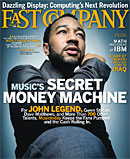 Never let a business touch a journalist's publication.
Last week, I had the grand opportunity to attend 'Backstage with John Legend,' a panel on music entrepreneurship and how artists are grabbing hold of their own careers in an age where intellectual property is hard to manage. The event was sponsored by FastCompany, a business-centric magazine that I thought was an upstart until I was told that the magazine had been around for 10 years but never really took off "thanks to mismanagement and poor business decisions."
At the end of the event, which was cordial, informal and altogether a relaxing good time (and educational, at that), I spoke with Dave Wolter, V.P. of A&R at Capitol Music Group and one of the night's five panelists that included Nathan Hubbard, CEO of Musictoday; Jorge Just, netroots manager for indie rockers OK Go; and Jason King, Artistic Director of the Clive Davis Department of Recorded Music in the Tisch School of the Arts at New York University (and my professor).
I spoke with Dave to simply say that I thought he was brave to be the music-label punching bag at an event where most of the panelists were shrugging off record companies entirely. I myself don't support the copyright-enforcing practices of his industry, but there are open-minded people who work at record labels, and I thought he spoke with an open mind instead of towing the industry line.
I also spoke with him about my own hard rock band, Dibble Edge, and asked him what he thought of the state of rock n' roll in modern music. He was reassuring - rock bands are still alive and thriving, despite the reduction of airtime on radio. He also reminded me to not count out MySpace, which many have said might become useless as a result of too many bands on the site.
Afterward, I spoke with FastCompany's Alex Pasquariello, who interviewed me and a classmate about the event. He promised both of us a mention in the blog post he was to write, and asked us basic questions that we both answered quite intelligently, given that we were taking a class on the same subject from one of the panelists.
The next morning, a huge post went up on FastCompany's site, but there was nary a mention of me or my classmate, neither the points we were trying to make. But he did, however, link (by request!) to the old OK Go video talked about during the event, but a new one not even mentioned that night, and used a good portion of the blog's word count to do so.
I figured, well, maybe Alex ran out of space. It's no big deal, even though he repeatedly promised. So I summed up what I spoke to Dave about in a few well-structured, linked sentences and posted it as a comment.
It never appeared.
FastCompany rejected my educational comment that augmented the very points he was making in his post.
But he didn't, however, reject a trolled comment that was a full-on pitch for someone else's business:
Hi. I am Javier, the founder of Trendirama.com, a community of online amateur writers. We write about the future of everything, and I would like to invite you guys to write an article on the Trendirama.com website, perhaps "The future of music in the US" or whatever you are passionate about? It is up to you, you choose the subject. You would get a link back when you link to your own article, if you wish. You can even re-use some of what you have here, in the last part of the article, "your view and comments". That would save you time and still be interesting for readers. Don’t underestimate this opportunity!Public be warned: Alex Pasquariello is not a journalist, and FastCompany is not an independent magazine.
Neither one subscribes to basic writing style, or worse, ethics. Journalistically, FastCompany is no better than an in-flight magazine in receiving influence from the very people it covers.
According to their website:
Fast Company magazine is celebrating its 10th anniversary. Launched in November 1995 by Alan Webber and Bill Taylor, two former Harvard Business Review editors, the magazine was founded on a single premise: A global revolution was changing business, and business was changing the world. Fast Company set out to chronicle how a new breed of companies create and compete, to highlight new business practices, and to showcase the teams and individuals who are reinventing business. Today, the business world continues to change, and Fast Company continues to evolve as well.
And according to editor Mark Vamos:
Our mission is to find the creative workers and organizations that are building the future, and to present their stories in smart, compelling, beautiful, and useful ways. This mission is the core of the magazine's original DNA; it's the brilliant bit that differentiates us from all the other business magazines out there.
No, Mark. The difference is that the other business magazines hire business journalists, not journalist businessmen.
It's not the rejection of my comment that infuriates me. In the grand scheme of things, I don't really care. Really, it is the blatant courting by a magazine of its own subjects under the premise that what the magazine is practicing is journalism. If this is how a magazine operates its blog, how can I expect any better from the magazine proper?
Many established consumer magazines straddle the line between influence and influenced - fashion magazines especially - but advocacy is different than explicit ignorance. To the magazine's defense, I did read through the issue they had at hand, and the articles weren't bad. But who is writing them?
Nevertheless, the blog comment rejection came right after a panel event where the main topic was how artists can embrace their fans directly. Ha! How can a magazine gain new readers when it won't even post an educated, concise response from a mostly unaffiliated person who attended their invite-only event?
FastCompany, it's no surprise that even after a decade, no one has heard of you.
Subscribe to:
Posts (Atom)


![Editorialiste [at] gmail](https://blogger.googleusercontent.com/img/b/R29vZ2xl/AVvXsEjzDvlHqUd5msfCmRq2Q5EZRpn_nbVg33bjiUhLEigM_5fudZhIHvuAVxB4_MS0xn-cQ0EKyjxOua1ysQ4NdMzyvhg1oSVTv6OJAarhVTqG0BBkJKTjqBhwMjrMGOANWxT8l8rKFg/s220/editorialiste_logo.jpg)