
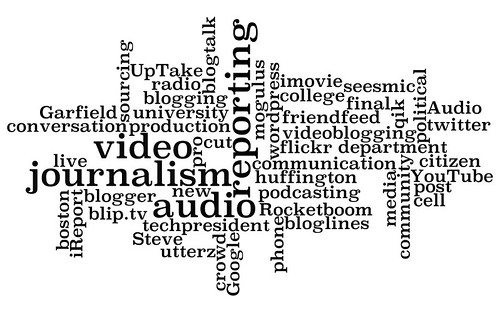
(Illustration: Steve Garfield)
I've had this discussion with a few people who currently practice in the general area that is "multimedia journalism."
At the highest echelon, are you more journalist or programmer?The
New York Times' multimedia team explains in
the latest Ask the Newsroom:
Aron Philofer:
As for learning these skills, there's some disagreement among those on my team with formal computer science backgrounds on whether taking computer science classes is worthwhile. Some say college courses are often too theoretical, but others believe that even the theory provides a solid foundation for problem solving. I wouldn't know because, like several other members of my team, I'm entirely self-taught. So I'm living proof that it's possible to learn enough to write a few production Web applications, manage a development team and not crash NYTimes.com (yet).
Gabriel Dance:
What I see far too often in journalism schools, and I feel is a mistake, is the idea that somebody can just learn computer programming in a semester or two. Developing interactives and projects on the Internet requires a love of computers and a deep interest in technology. Most of the time, people develop these skills on their own, or pursue a technology-related career. If you really feel that you want to be a journalist-programmer, I encourage you to take some courses in the computer science department. It will give you the foundation that you just can't get by taking a couple of Flash courses.
Steve Duenes:
The journalist portion of the journalist/programmer combination shouldn't be neglected. We've had a number of strong technological performers pass through our department, and some of them had difficulty knowing which information to pursue or how to pursue it efficiently. Some had interesting ideas, but they weren't able to fully articulate what they wanted to do, and as a consequence, they were frustrated when we had to make decisions about which graphics to go after.I'm not saying that a master's degree in journalism is the thing to do. It might be. But the important thing is to find an environment where you'll be pushed and where you can grow. If you're surrounded by a few people with good experience and if your internship or job requires you to behave like a journalist, that's good.
From my experience -- self-taught but not extensively so, thus better than the average new media graduate but poorer than the average programmer -- a journalism grad with new media experience is no longer the desired employee for the leading online publications (like the
Times). More often, it is the programmer who took a few journalism courses, rather than the other way around.
The good news is that means the bar is much higher now, ever rising, and stories can and will be told with such depth and nuance thanks to a team that has mastered the tools needed to express them.
The bad news is that a new media journalism graduate who wants to work in multimedia won't be able to at the highest levels without some
serious coding expertise under his or her belt. In other words: perhaps a master's degree in computer science will do you more good than one in journalism.




![Editorialiste [at] gmail](https://blogger.googleusercontent.com/img/b/R29vZ2xl/AVvXsEjzDvlHqUd5msfCmRq2Q5EZRpn_nbVg33bjiUhLEigM_5fudZhIHvuAVxB4_MS0xn-cQ0EKyjxOua1ysQ4NdMzyvhg1oSVTv6OJAarhVTqG0BBkJKTjqBhwMjrMGOANWxT8l8rKFg/s220/editorialiste_logo.jpg)