Well, some of them.
Fox 29 Philadelphia chief meteorologist John Bolaris reports:
I doubt this is in compliance with News Corporation's social media policy.
Update: Philly.com's Dave Merrell makes a sound suggestion urging for pre-tweet troll education. I agree; many news types aren't used to managing their own reader mailbag, much less in real time.
Showing posts with label online journalism. Show all posts
Showing posts with label online journalism. Show all posts
Friday, September 02, 2011


Wednesday, August 31, 2011
Jobs you'll have as an editor.
The job title and role of "editor" often means much more than its literal definition.
A list of jobs you might have while you're editing a publication:
A list of jobs you might have while you're editing a publication:
- Intern
- Writer
- Reporter
- Copy Editor
- Assignment Editor
- Photo Editor
- Special Projects Editor
- Researcher
- Administrative assistant
- Sales account executive
- Product manager
- UX designer
- Creative director
- Customer support specialist
- "Evangelist"
- Marketer
- Communications director
- Audience acquisition specialist
- Social media coordinator
- Event planner
Wednesday, June 22, 2011
Five things I learned from Brian Lam.
Gizmodo editorial director Brian Lam left his post today after five years. I think he gets a lot of attention because he helms the web's most distinct tech site, but the chatter about his role over the years overshadows his talents in shaping a publication's voice.
Five things I learned, or relearned, watching him as a contemporary working in the same space:
Five things I learned, or relearned, watching him as a contemporary working in the same space:
- Hustle. He'll try new editorial features, give his writers room to cover topics they love, go for the mainstream jugular and not apologize. And he'll never spend an ounce of Arringtonesque energy hyping it.
- Public relations reps are not there to help you. There's a reason Brian always flipped over his badge at the Consumer Electronics Show: he was working.
- Upend conventional wisdom. He hires nobodies and molds them instead of blows cash on big names. Buy low, sell high. He's bold, but he's not reckless.
- Don't lose your soul. Brian always had my respect because he never appeared chained to his laptop. He knew when to unplug and head to the water's edge. Work to live, don't live to work. It's a West Coast lesson some of us East Coasters ought to learn.
- The brand matters more than its parts. He's easily accessible, but he shuns the spotlight. (See CES anecdote, above.) He keeps his life private, but his opinions widely available. He puts his writers in front of him, prioritizes a narrative where necessary, defends his employer's efforts, doesn't hedge around the truth, and treats everyone equally regardless of title. It's a very old school way of working, but he's managed to demonstrate it in a very new school setting.
Tuesday, June 14, 2011
Break away from the news cycle.
 The news cycle is a drug.
It's what every journalist pines for, to some degree. We're all addicted to it a little -- it's why we're in this business. But when we all end up running the same race, like hamsters in a massive wheel, the cold hard fact is this: only one person wins a race. The rest lose, exhausted.
Do readers a favor: ask yourself -- really, ask yourself -- if you're in the business of breaking news.
If you are, best of luck (and a double espresso).
If you're not, stop trying to be. You're doing a disservice to readers by trying to break news and failing -- either by speed or quality.
Zig instead of zag. Rediscover your publication's mission. (Ask yourself if it even has one.) Do what you, not others, do best.
Win hearts. Win minds. (And maybe profits.)
P.S. I realize I haven't been keeping up this blog; its mission remains relevant. I plan to spend more time on it.
Sunday, February 06, 2011
The battle against press release-based news.
 The Atlantic Wire, demonstrating its own growing ability to offer valuable original content, recently ran a piece about Gawker Media founder Nick Denton's reading habits.
 While the piece is itself interesting in a voyeuristic, what-does-the-gossip-merchant-read kind of way, what's most notable is Denton's ability to portray his reading habits as a reflection of the publishing business at large.
He says to John Hudson:
I learned the news business in the UK, in which newspaper political coverage is much like cable TV news in the US. Fake news, manufactured, hyped, rehashed, retracted -- until at the end of the week you know no more than at the beginning. You really might as well wait for a weekly like the Economist to tell you what the net position is at the end of the week.To follow the daily or hourly news cycle is the media equivalent of day-trading: it's frenzied, pointless and usually unprofitable. I'd much rather read an item which just showed me the photos or documents. And if you're going to write some text, take a position or explain something to me. Give me opinion or reference; just don't pretend you're providing news. That's not news.
Immediately before this excerpt, Denton says, "Journalists pretend that these official statements and company press releases actually constitute news."
That might sound surprising from the fellow who publishes Gizmodo and Gawker, both which post endless streams of spokesperson-originated news. But consider that Denton has been pushing for original content since the very beginning. (Exhibit A: Elizabeth Spiers' "Coke - The Perfect Dealer" on a very young Gawker site.)
The difference, in my opinion: he recognizes that limited resources and a 24/7 news cycle require some of this pandering. (One major difficulty of a website: there's no "next issue" on which to wait. Denton can't afford to have everyone off crafting an opus when there are 40 posts to manufacture for eyeballs that are already waiting for them.)
On the other hand, now that Denton's company is growing in size, success and reputation, that's precisely why you see exclusive news scoops and a healthy dose of assigned -- yes, assigned -- feature writing.
Mainstream news organizations got it wrong. It wasn't the aspect of blogs repurposing their original reports that was the threat. It was blogs creating a voice around them, a style, and then building an audience from it.
What big news organizations didn't see coming was that some blogs would gain enough success (and resources, and reputation) to eventually challenge their ability to provide content with value.
Monday, April 26, 2010
Modern reporters read too much news.

The problem with reporters in the 21st century is that they read too much news.
A big story -- about how California law enforcement officials used a warrant to search the home of a Gizmodo editor for clues about a leaked Apple iPhone prototype -- is making its way around the Internet today.
It's great fodder for many things: First Amendment rights, shield laws, journalistic ethics (paying for scoops), and so forth.
(A small aside: whether you agree with him or not, we ought to thank Gawker Media founder Nick Denton for his attitude and cunning when it comes to operating a media business and showing that "the rules" are just a mirage. Like him or not, the spirit of his efforts should be commended.)
But the constant recycling of watercooler chatter visible from my Twitter perch has reminded me that good ideas are hard to come by.
So very many publications reposted the Gizmodo-iPhone news as soon as it hit.
They did this because:
- They want to demonstrate that they're covering a beat thoroughly.
- They want to show that they're a source of breaking news.
- They want a monopoly on as many readers' eyeballs as possible.
- They want to fuel as many clicks as possible, which they believe (wrongly in some cases) will help please advertisers, build brand value and pad paychecks
But very few added any real value to the discussion, and most just did a good job of obscuring the real source of the news: Gizmodo itself.
I wish online publishers could figure out a technological solution to reposting others' content and giving them monetizable credit for it, for both byline and clicks.
(In fact, Gawker Media used to practice an in-house way of doing this: you'd see a story from, say, Lifehacker in the Gizmodo feed, and clicking it would take you right to the Giz story -- no reblogging or content swapping necessary.)
If every publication in the online ecosystem stopped spending valuable resources reblogging each others' content, perhaps they could actually utilize those resources to produce original stories.
Of course, that changes the playing field a bit: outlets such as the New York Times rarely need to "reblog" another publication's content because they have a wealth of reporters at their disposal to ensure readers get their fill on their website; conversely, tiny outlets such as The Business Insider would lose regular attention because they don't have the staff to produce enough original news to sustain a reader on a regular basis.
I understand the value of information exchange on the Internet. I believe it is the web's defining characteristic, and limiting it (such as not linking off to external sites) would be of little use to the greater ecosystem.
But I believe there is too much recycling of information going on -- so much so that the original source doesn't get enough credit, and rebloggers get just enough to continue doing it endlessly.
In other words: it's just too hard to navigate the news.
But I'm not approaching this from a high-horse journalism point of view. I'm simply looking at it from a reader's. It's massively perplexing to suddenly see an endless parade of brief, shallow stories about the same crumb of news.
It fosters no loyalty, as far as I can experience -- only loyalty to who can break news first, which, in the age of Twitter, is a tenuous goal.
Which brings me, long-windedly, to my main point: modern reporters simply read too much news. Their coverage is often clouded -- rather than informed -- by previous coverage of the same topic by other publications.
They fail to approach topics by a new angle.
They fail to ask questions.
They fail to offer value to the reader.
The Internet is a wonderful thing. It has allowed us to be more informed than ever before. (Surely I'm not the only one who has spent hours reading obscure Wikipedia entries for my own edification.)
But it has, in a way, served to stunt a reporter's effectiveness. It's too easy to keep an eye -- two, even -- on rival reporters on the same beat. It's too easy to pursue self-fulfilling scoops that dovetail on previously published scoops.
It's too easy to internalize the way others write.
The way others think.
The way others report.
This kind of thing can veer off into plagiarism, which I believe is easier than ever in the age of copy-and-paste -- no malicious intent necessary.
It can also quickly become inside baseball, with reporters reporting on reporters' reporting. (The press release-fueled gadget beat? Full of this.)
But I also believe it makes for a fairly useless reporter.
I want my reporters to be somewhat aloof. I want them to read up on previous coverage and basic facts about a topic, sure, but I also want them to ignore who wrote it, and when, and who else may be covering the topic.
There's a bit of value in having an informed reporter operate in a vacuum, working disconnected from the news cycle.
Let the editor be their tether to it.
Friday, March 05, 2010
The truth about the price of investigative journalism online
 The folks at The Business Insider went and practiced some true investigative journalism in a story about Facebook.
What they found out: in the current online-only business model, true investigative journalism is unsustainable.
Here are their tweets about the project, via editor-in-chief Henry Blodget:
All right, look, here's the truth about this investigative reporting thing...Everyone says they want more of it. No more aggregation, please. No more links. No more slideshows. No more picture of Erin Burnett.Just more good old shoe-leather reporting, like they did in the good old days.And so we do it!A good old fashioned shoe-leather investigation. On and off for two years. Wheedling, Cajoling. Secret meetings. Documents. Hush hush.And we find out some cool stuff! Not Pentagon Papers or Watergate, mind you. But good, secret stuff about the founding of FacebookAnd then we have to chat with lawyers: What happens if Facebook sues our asses off? Will we get tossed in Big House for protecting sources?And then the fact-checking. And the "hey, guys, sorry, we've got this story you're not going to like" call with Facebook. (First of many)And we have to write and edit the darn thing, which takes, literally, all night (I sh** you not)And we have to make sure it's correct and fair, because who doesn't want to be fair? I mean, these are just people. And who's perfect?And because we don't have some massive staff of 8 editors per writer or something (no wonder NYT going bust), this is a tag team effortSo, anyway, we do the investigative reporting thing. And we produce a good story! Interesting, fair, fun (IMHO). Breaks new ground. Etc.And people like it! (Except for one guy, who says he'd rather watch ice melt than read about Mark Zuckerberg). Kudos. Sense of pride.And of course we'd love to do three of these a day -- figure out all the bad sh** in the world, get it out there, help people know beansBut the truth is, if we tried to do 3 a day, with our staff, we would DROP DEAD. We'd also go bust. Neither being a happy outcome.So that means...We're going to try to give you one of these once in a while. You like reading 'em. And we like making 'em. So it's smiles all around.AND...We're ALSO going to keep giving you the great stuff that OTHER sites are doing (hopefully with some helpful commentary attached).And we're going to give you house porn, and features, and pictures of Erin Burnett. Because, truth be told, you GROOVE on that sh*t!(And so do we, by the way--we've taken our fearless moral inventory, and we're ready to admit it)And because, thanks to the Internet, there are THOUSANDS of smart people publishing great stuff. And it would be SILLY not to link to it.So that's the truth about investigative journalism. It's important. It's great. But it is also fantastically expensive and time-consuming
So there you have it. Online, it's impossible to sustain such investigative journalism, because the budgets just aren't large enough (probably because print is still taking quite a chunk of advertising dollars -- the split isn't helping either side) and thus neither is the staff.
That's the thing about online -- pages need to be made every day. Who's going to turn over pageviews while all your reporters are off doing stories that -- while immensely helpful to your publication's reputation and brand -- eventually don't pay off in terms of pageviews?
Say you get 200,000 pageviews on a great investigative story, but it takes you a solid two weeks (not very long in investigative journalism land) of work to do.
You've given up whatever pageviews you would have made during those two weeks -- and even if you break even, your site has been silent for two weeks. (Unless, of course, you have a big enough staff to do so. Most online-only publications do not.)
See the problem? Investigative journalism is extremely expensive no matter which way you cut it, but it's impossibly expensive for an online publication. When you can get 100,000 pageviews on a photo gallery of Miley Cyrus, and another 100,000 on a post about the Apple iPad -- in the space of two to three days -- why bother with investigative reporting?
Like the newspaper industry as a whole, it's a "public service" that must be subsidized by more profitable, but less glamorous, content.
(Ergo, why Blodget decided to publish a photo gallery with 22 -- yes, twenty-two! -- screenshots of his already-published tweets that can easily be read in chronological order from his Twitter page. Because publishing is a business, and online, pageviews rule.)
A recent Columbia Journalism Review survey noted that magazine websites' editing practices were "slack" and not up to par with their print counterparts.
It's the same problem here: without budget and staff, you simply can't guarantee the same quality.
This is not an online versus print culture clash. This is as simple as balancing your checkbook. If editorial oversight comes at a premium, investigative journalism is simply out of reach for most publications.
Wednesday, December 30, 2009
To aggregate, or report? On successful online publishing

If there's one issue online publications have really battled with, it's the teeter-tottering relationship between the creation of original work and the aggregation of third-party content.
For years, most news organizations have operated under the guise that everything in their (newspaper, magazine, website) was original. But hawk-eyed readers would notice the "Associated Press" (or "Hearst" or "Cox" or "AFP" or...) bylines in the newspaper, and note that such content was republished from somewhere else.
The reasons for doing so are many: sometimes it's to fill space in a regional paper without resources; other times it's to ensure broad (Washington, D.C.) or acute (New Haven, Conn.) local coverage without committing costly resources.
The same thing is occurring online, and that's no surprise as the digital medium matures. The problem now is that stories break online, which means they can be republished very, very quickly without clear insight (or regard) as to who originally reported the story.
Online, the struggle remains over how to properly attribute content. (It certainly doesn't help that publications don't establish style rules for this.) But what's really interesting is how websites -- particularly smaller ones -- are filling the gaps.
In an interesting dicussion via Twitter yesterday, Gizmodo editorial director Brian Lam and AllThingsD senior editor Peter Kafka exchanged a few questions about building a digital publication around the (expensive, time-consuming, valuable) creation of original content versus the aggregation of (free, quick, with little lasting value) third-party content.
Here's the exchange:
Brian Lam: the net's greatest threat to journalism is not old vs new, its that reporters no longer get as much exposure to new sources in real life.Peter Kafka: @blam biz problem, not tech. Encourage reporters to walk around, make calls, they will. Reward them for reblogging, they'll do that.Brian Lam: @pkafka true. but remember, in old media, they rereported stories from scratch that were already written by comp., instead of links. worse!Peter Kafka: @blam true dat. plenty of old-media was (and is) essentially reblogging. that's my point - not tech, but biz model.The Editorialiste: @pkafka @blam so how to solve biz model incentive problem? what's the answer?Brian Lam: @editorialiste I think its a judgement call between aggregation and reporting. and a resource thing. reporting is expensive if done old way.
The very reason this exchange can occur is because of the Internet's link-based economy: now, you can legally, through fair use, reproduce a paragraph or so of someone else's content, so long as you attribute it to them and include a link back to the original work.
Never before was that possible in such a dynamic way: often, newspapers would cite reportage by other papers, but in newsprint, there was no link to help you find it. Similar but worse, broadcast organizations often based their own coverage on original newspaper reports without citing the original source at all.
The exchange also shows that online players -- my peers, since both write for competing publications about technology -- are constantly thinking about the online business model.
Both AllThingsD and Gizmodo stay afloat with some level of reposting third-party content -- sometimes it's a copied quote, link and original analysis; other times it's a rewrite of a scoop first published by another publication. It's a particularly popular thing to do in technology coverage, since so much of it is based on products, and therefore based on nonexclusive press releases.
However, both sites regularly offer original content. In the Wall Street Journal tradition, Kafka often reports on the inner dealings of tech companies. Lam's team publishes tips/scoops on unreleased gadgets with some regularity.
Both offer a mix of original and aggregated content. At the time of writing, Gizmodo counts 15 names on its editorial masthead (plus a regular columnist, plus two interns); AllThingsD counts five names on its editorial team (plus a columnist, plus an intern).
Not all of Gizmodo's 15 are full-time, and many AllThingsD's staff double as full-time reporters for the Wall Street Journal. For both, aggregation is important -- there's simply no way either publication can cover everything quickly and originally.
The problem, of course, is to what degree. Both Brian and Peter make valid points in the conversation above:
- How do you stay on top of breaking news if you're always doing original reporting?
- How do you become more than a regurgitation mill if you're always rewriting or rereporting third-party content?
- And is online reporting really the same as what mainstream media used to do, just more transparent?
As Brian notes above, it's a matter of resources. Online media garnered eyeballs by reposting everything it possibly could -- that's how it got its popularity. With popularity came some degree of money, which allowed for more staffing, which in turn allowed for more original content.
Gizmodo is a great example of this: it first made its name finding everything it could on the web about tech and transformed itself into a portal for the topic. Once it achieved a large audience (and money), it hired more editors to handle the aggregation, while its original team moved into original content.
Now, Gizmodo's become more of a magazine: it's got a cadre of low-level editors working on the day's quick-hit breaking news; it's got several regular columnists offering value through analysis; it's got a couple of high-level editors who work on what magazines call "special projects": regular features, or one-off special runs of coordinated content.
Unlike tech rival Engadget -- which has surpassed Gizmodo in absolute pageviews -- Gizmodo is now trying to differentiate by offering value through original ideas. (Engadget's done a measure of this too, but not nearly as much.)
And wouldn't you know it, Gizmodo has been making content-sharing deals with several popular tech websites. Gizmodo has become, if I may be so bold, its own wire service. (And other publications indeed find it cheaper to repost Gizmodo's content. But is that such a smart idea on the web, where you can always easily access the original version? That's for another blog post.)
(AllThingsD I'm leaving out of this, since so much of its content derives from the Wall Street Journal's regular reportage. However, the site has established a separate "Voices" section for outside, reposted coverage.)
Kafka's point above is that the business model forces trained reporters to work on unoriginal content, which I agree with. But it's Lam's point about budget that's really central to the situation. With a growing budget, more popular publications can afford to hire staff to work on original content: new features, marquee columns, event coverage.
With a modest budget, even the most bootstrap of reporters must resort to reposting or opining to keep the content flowing in between bouts of original reporting. (Unless a larger parent company is willing to subsidize this costly original reporting; see: Condé Nast and The New Yorker.)
So what's a publication to do? How do you leap the hurdle to move from repurposed content to original reporting? After all, you don't want to hire a full staff of reporters if you don't yet have the popularity to draw the eyeballs -- and thus earnings -- to support it.
Similarly, you don't want to hit a traffic ceiling in which you've got each one of your few reporters pushing content at full-tilt -- so much so that it's to the detriment of their work. That's also unsustainable.
(A side note, by the way: it remains unclear whether aggregation itself is sustainable. Can publications become news portals, or will that be the exclusive territory of Google, Yahoo and Comcast? Will we then begin an arms race for original reporting, or does non-automated republished news still have enough ROI to make it worth the effort?)
Aggregate, or report? On its face, it seems you don't really have a choice. Your popularity dictates the answer to that.
The challenge, then, is how to graduate from one sphere to the next.
Wednesday, November 18, 2009
On reader (and viewer) loyalty
I received a call this afternoon on my cell phone from a dance company that I see perform once, perhaps twice per year.
The company's spring season is around the corner, and the sales representative wanted to offer me, the customer, a package subscription deal that allowed me first crack at reserved seats for shows in May, June and July.
The catch? A subscription entails four different shows in a row, same time and day of the week.
After several minutes ducking the hard sell, I politely declined the offer. I did the same exactly one week ago to another representative. I did the same last year to two or three more.
By most standards, I'm a casual customer. I don't follow the individual shows and seasons, and I only attend when I have the time and money. My ticket purchase history reflects this impulsive streak.
But the company continues to call my cell phone and insist that because I'm a loyal customer -- having seen one show this year -- I ought to consider signing up for three times as many shows I usually see, six months in advance.
An e-mail advertising the new season probably would have been enough to get me to convert. (Cheaper, too.)
If a customer/reader/viewer/user is on your list, it doesn't necessarily mean they're loyal. It means they're interested.
The growth of the web (and RSS, and Digg, and Stumbleupon, and Facebook, and Twitter, and...) has created many loyal customers, but it's also created plenty of interested customers.
Both are valuable.
Monday, September 21, 2009
What is a successful online media business?

How do you measure a successful online media property?
By awards?
By pageviews?
By unique users?
By profit margins?
I struggle with this question each day.
Name recognition is valuable, but not if you don't make enough money to survive.
Popularity is deemed essential, but how do you make money from all that attention? (Surely you've got a better idea than banner ads.)
Profit margins are the mark of a successful business, but making a killing on a single customer might not pay the bills.
Luxury goods makers know how to make lots of money from few people. (The ones that don't have enough customers -- some couture fashion houses -- are dying as we speak, margins be damned.)
Electronics manufacturers know how to sell many products to many people, but need tremendous volume to make up for thin margins.
Media outlets know how to create engaging, original content, but must keep up a side business (classifieds, ads, retail products, sports teams, educational-prep services) to fund what's otherwise an unsuccessful business.
Some companies subsidize each method's shortcomings by offering both or several models.
But bloggers measure their success by pageviews.
Can you be successful with a small amount of influential, engaged readers? (Perhaps with a subscription.)
Can you be successful with a large amount of apathetic, fair-weather readers? (Perhaps with those advertisements.)
There is a limit to how many readers you can reach with the kind of content you offer and the monetization scheme you've designed. Isn't there?
A foolproof online business model has not yet been made. It's still the Wild Wild West out there.
Don't forget it.
Thursday, September 10, 2009
A 30-year magazine veteran fights to keep storytelling relevant online

When's the last time you were told a great story online?
(Probably not in a long time.)
He's taking a magazine-style approach to interactive multimedia storytelling with a new venture, FLYPmedia.
I interviewed him for SmartPlanet, CBS' new site about smart technology, business, people and ideas.
Though FLYP is still in its infancy -- it reminds me of some of the work I did as a digital media student in journalism school -- Jim made some interesting insights as a 30-year veteran of magazine publishing moving toward the Web:
- "There are publications that are in print that don’t need to be in print and could be much more exciting in a digital frame."
- "Text is not the most the important element. It’s really a navigational device that leads people through the media."
- On producing interactive media: "It's like jazz. You all kind of stimulate each other. And it turns out better than anything you could have done yourself. When a video editor makes a great piece, it changes the story. When an animator does a great animation, it’s the same effect. It raises the game."
You can read the entire interview here.
Monday, April 20, 2009
New media reality check: The skills you really need in the real world
 I've had several people e-mail me with the following question:
"I'm a print/magazine/broadcast student, but I want to get into new media. What courses should I take/which j-school should I go to/how should I prepare so that I can get a job when I graduate? You were a new media student, Ed. Tell me -- how can I get hired?"
If you were wondering the same thing, you're not alone. As the economy tanks and media outlets of all persuasions cut back, lay off or refuse to hire, I'd be nervous, too. (And I was.) Everyone and their mother is telling you that you need new media skills to compete.
You must be a one-man-band of multimedia glory, they say. You simply aren't a journalist unless you're carrying a laptop, camera, camcorder, pen and pad all at once!
You must be a one-man-band of multimedia glory, they say. You simply aren't a journalist unless you're carrying a laptop, camera, camcorder, pen and pad all at once!
Shaking in your boots yet? You ought to be. Because there are very few people that can do that job.
The good news is that it probably won't be you. As new media has increased in popularity and usage, this myth has populated of the multi-talented reporter -- you know, the one carrying all the gear a few paragraphs back. And while it's certainly an ideal, it's not a necessity. In fact, it's barely a reality.
Thus brings my first point of this New Media Reality Check: most news organizations simply don't operate that way.
Do you remember how Henry Ford became famous? He did it with the Model-T, which was innovative because it was built on an assembly line. So instead of one worker needing to know how to put together an automobile from start to finish, workers were trained to be very good at one specific thing -- putting on a wheel, or attaching a transmission to an engine, or checking for defects. It made the process more efficient in both cost and speed.
The same thing applies to publications, moreso as it gets bigger. Whether the publication in question is a newspaper or a magazine or a radio/TV station or a website, the assembly line theory of the Industrial Age still holds true: a writer reports and creates the story, an editor edits it, a photographer shoots art for it, a production editor lays out a template for the story to appear and another editor (or two) looks at the entire package, all while being fact-checked and copy-edited by another person dedicated to that task.
As you can see, no one person does it all -- the photographer sticks to his or her camera, the reporter sticks to his or her story and the production editor doesn't typically interject his or her opinion about the reportage. Each person is a cog in the machine -- the bigger the machine, the more cogs, and vice-versa.
So how did we come to expect a journalist to do the same thing?
The reality is that, in most newsgathering organizations, you will have a specialized task. Maybe you'll be an interactive producer, spending your days working with Adobe Flash (in which case, you probably have a computer science degree.) Maybe you'll spend your days producing slideshows and simple infographics. Maybe you'll blog. But you'll rarely do them all.
So here is my second point of the New Media Reality Check -- my advice to journalists looking to get in on the new media game:
If you're just starting out j-school or a similar educational program, think about what you'd like to do when you graduate. Do you want to work in broadcast television? Do you want to work online? Do you want to work in print? Radio? Whatever it is you think you want to do, pursue the skills needed for that field within your studies. It's that simple. If you want to dabble in other skills, that's fine. But you don't have to as an online journalism prerequisite.
If you're already a journalist, or you're in a print-specific educational track (newspaper, magazine, etc.), consider where you want to end up, job-wise. Do you want to be a photo/video journalist or interactive producer? Then you'll have to attain specific skills, via a proper class or a dedicated friend (or yourself, if you have time). Do you want to simply be able to write online and be comfortable with the Web? Good news -- my advice to you is the following: Don't return to j-school, and don't take a course.
A blog isn't a diary anymore. It's parlance for a type of publishing platform -- you now have the very machinations of a publication at your fingertips, for free. Once you start one, start playing around in the HTML editor of each post. Start reading about CSS once you've got a handle on HTML and its code snippets called "tags." And post about something on your beat. Or journalism. It doesn't matter.
That's it! You now know everything needed to work online. Seriously.
For most online journalism, all you need to know is how to blog and how to use a CMS, or content management system. That's it. What does that entail, exactly? Allow me to lay it out for you:
How to blog
Know how to write a story in Microsoft Word or on paper? Great! That's 90 percent of what you need to know to blog. Seriously. If you can write with clarity and an engaging demeanor on first draft -- which I believe is the skill to have in 21st century journalism -- you're already ahead of most people.
What about the last 10 percent? Well, the first 5 percent is learning basic HTML. For example, the little pieces of code, or tags, that allow you to bold and italicize and insert an image (which you may have to size appropriately). You may be able to do this using a "visual editor," which doesn't show tags, but you should learn how they work. That five-minute lesson will save you when something goes awry as you write.
The last 5 percent? Getting over the mental hurdle of hitting the "publish" button. Some publications have bloggers who are edited; others don't. And it has nothing to do with how big or prominent the publication is, either. So whether you're writing a column or a piece of investigative reporting, there's a good chance you'll have to publish it yourself, live to the website. All it takes is pressing "publish," but you'd be surprised how many journalists don't realize that they have that power at their fingertips -- and even more surprised at how many refuse to use it.
How to use a CMS (content management system)
This is actually a trick question. The thing is, CMSes are proprietary -- meaning they vary from publication to publication. Many larger publications have their own customized CMS. Some combine a CMS with a blog publishing platform! (You'd be surprised at how many sites/outlets are in this group.)
In other words, there's no way you can learn something that only applies to a single publication. And neither can online journalists who work elsewhere! If you, esteemed print journalist, and I, online journalism fan, both apply for the same job, we're pretty much in the same boat when it comes to that publication's CMS.
So what should you do? You started that blog I told you to sign up for above, right? Good -- a blog is a kind of CMS, so by filling out the "headline" and the "tags" and other fields, you were doing the exact same thing you would do in a CMS. Really!
Congratulations. You're an online journalist!
Pretty easy, huh? Notice I didn't mention anything about splicing video in Final Cut Pro or Avid, or mixing audio in Pro Tools or Audacity, or using Adobe Flash. Perhaps you'll use Photoshop, but likely only to resize images.
That. Is. It.
That. Is. It.
Allow me to repeat: you will not use any of these expensive, complex tools for the majority of online journalism jobs. You may down the line, but it's exceedingly rare that anyone will expect you to have prior knowledge of any of those skills.
I spent much of my "new media" journalism time playing with Adobe Flash and Final Cut Pro. The thing is, I didn't take a job doing interactive or video production -- so believe it or not, I haven't cracked either program since I finished my formal education. None of it truly had any bearing on my job prospects, and by the time I'm shopping around for my next job, I'll be so many years out of the loop that I won't be able to rely on those skills if I decide to switch.
I'll be honest, I did enjoy playing with those programs late into the night, because I learned a lot about myself and how I learn things. But I didn't need them to work online, which I currently do full-time (as in, when the Internet is out, I cannot work).
I'll be honest, I did enjoy playing with those programs late into the night, because I learned a lot about myself and how I learn things. But I didn't need them to work online, which I currently do full-time (as in, when the Internet is out, I cannot work).
What I do wish is that I had spent more time learning lower-hanging skill fruit -- CSS, which is a coding language similar to HTML, and formal design and layout classes, because I'd like to produce my own online publication beyond The Ed. CSS and design skills are far less specific, and much more widespread in their use (and helpful in their implementation), than Adobe Flash or Final Cut Pro (for the typical online journalist). Period.
So: you wanna be an online journalist? If you haven't started yet, plan accordingly. If you have, skip the formal classes and start a blog. Then stop calling yourself a print journalist -- because we're all online journalists now.
Wednesday, April 15, 2009
The problem with magazines à la carte
 When Time Inc. first announced its plans to offer its magazine content à la carte, called "Mine," my first thought was that it was catching up with the times. After all, isn't that what people do on the Web? Pull what they deem the best from several different (and sometimes competing) publications?
But instead of posting, I thought I'd sit on the idea for awhile and let it stew on the backburner of my brain. It's never wise to rail against or praise a business model in a knee-jerk kind of way -- these things are often more complicated then they appear, and business models are chock full of competing interests.
Now that I've had some time to think about it, it occurs to me that with "Mine," certain magazine staff are getting the short end of the stick.
First, let me explain how Time's offering works. The consumer gets to pick five titles from the Time Inc. stable -- the largest in the business -- and soon that reader gets tailored issues pulling content (or stories, in the printed parlance) that matches his or her interests.
Interested in the executive life? You'll probably get material from Time, Money, Golf, Food & Wine and Travel + Leisure. If you're more a fashionable jet-setter, perhaps a combination of Real Simple, InStyle, Travel + Leisure, Time and Golf.
You get the idea.
Curiously, some titles that would match others are left out of the mix: Fortune. Coastal Living. People. Essence. Entertainment Weekly. Wallpaper*. Cooking Light. This Old House. Et cetera.
I suspect that decision is threefold: to avoid pillaging the company's entire portfolio; to keep subscribers of several magazines (it's likely that a Money subscriber already also gets Fortune; a similar possibility exists for Travel + Leisure and Coastal Living) subscribing to distinct publications; and to make sure that advertiser dollars are coming in without them trying to shortchange established rates for individual publications.
Whatever the reason, though, I don't like it. It seems to be a massive convenience for the user, but it really takes away from the point of a magazine. And that's what gives me pause.
Magazines are powerful because they are packages. Whereas newspapers are intended to deliver information quickly, magazines are intended to be leisurely read, analytical (or, at the very least, big picture) and a form of entertainment. They are less an information vehicle as a leisure activity, so much as information can be entertainment.
A big part of that "package" is the design, layout and story selection of the magazine. A big part of editors' (and publishers') jobs is to make sure that the magazine flows from cover to cover. It's not a piecemeal exercise. Magazines are, by their nature, a curated collection.
So while magazines a la carte seems appropriate in a world of RSS feeds and customizable content delivery, it's really at odds with the very nature of a magazine. It turns magazine content into, well, content -- separating it from the infrastructure that a magazine issue provides. And that's a problem for the editorial and business departments alike.
I've previously criticized magazines for not jumping on the Web sooner and in a better fashion. My argument was that they were missing a great branding opportunity, a great chance to extend the brand with far less overhead than a spinoff publication (Vogue Living, I'm looking at you). There's no reasonable limit to how much content can be produced on the Web. And the price of ink and paper doesn't even factor into it.
Of course, the challenge of the Web is in reproducing the perfected magazine form in a new medium. So when I look at this a la carte service -- which eschews planning altogether, reducing magazine content to words -- I cringe.
And that's exactly what Time Inc.'s "Mine" is -- unplanned. It's offered to you in printed form or via online delivery to your inbox. I haven't had the pleasure of seeing either form (Time Inc. doesn't offer you a preview without you handing over all of your vitals), but I can't see it being a successful publication in its own right. The content is generally disconnected from itself, it may overlap and it, in all likelihood, has little flow to it. It's a very utilitarian approach, which is at odds with magazines as entertainment. They're simply not necessary to live. They're just nice to have.
The "Mine" endeavor smacks of marketing, and very little of editorial. There's nothing wrong with that on the face of it, but if the company wants to effectively create a new publication, it will need oversight. And it takes at least half a traditional magazine staff just to curate previously-published content in a way that it could fit together. Even then, the fit isn't perfect.
Above all, new endeavors must pass a simple litmus test: does it solve a problem? (Or does it make enough money that it doesn't matter?) I see neither of these options. By offering "Mine," Time Inc. is backhandedly shunning the work its editors and art directors for the (likely freelance) writers. It doesn't solve the magazines-on-the-Web problem; it doesn't solve the declining print circulation (and thus ad revenue/pages) problem.
So what's a publishing house to do? Well, in a global economic downturn like this, it's to make sure its portfolio (and thus its staff) is lean and mean, both in printed and digital forms. "Mine" just strikes me as fatty excess, even though it appears to be a cost-saving way to reuse content.
With such limited appeal, exposure and choice on the part of the consumer, I doubt any "magazines à la carte" solution has the legs to stand the test of time. With "Mine," you can have it.
Friday, February 13, 2009
Tina Brown and the fight to save journalism

If you're a writer, get out of your comfort zone.
If you're an editor, surround yourself with writers.
And if you're starting an online publication, do so with conviction. It will work.
Eventually.
Brown's Daily Beast -- for which at least one friend of mine writes -- has been in the spotlight since its launch last fall. A new media venture by an old-media person, if you will. An online pubication brave enough to not accept (interns aside) free work. A digital venture (questionably) backed by IAC's Barry Diller.
But Brown revealed last night that the venture is very much her vehicle for figuring out how publishing can survive in a "free," online-only environment. Correction: not just survive, but thrive. And in this current state of media flux, it's exciting to me to know that someone is pursuing something with conviction, and not floundering about trying to stay afloat.
Highlights which I'd like to pass along to you, readers:
- Deploying narrative journalism on the web successfully is Brown's greatest challenge.
- The Daily Beast continues Brown's tradition of high/low coverage (or "class and trash," as I like to call it.)
- Some of her best writers didn't start as writers at all. Some of her best writers were passionate about topics they weren't writing about for a living. It was Brown's challenge -- and naturally, to her benefit -- to correct this. Example: Dominick Dunne, whom she told to keep a diary; Jeffrey Toobin, whom she simply gave enough time to develop his own (less-than-legalese) voice.
- Editors must "make their world writers," and surround themselves with them. They are immensely creative people, she said, and you must know their strengths and weaknesses and, of course, always have talent on hand.
- A big area for development is in-depth, feature-length business journalism. Not closing-bell coverage, but CEO profiles and such things. "Capture characters," she said.
- The Daily Beast is doing what newsweeklies should be doing -- analysis and less breaking news coverage -- in the smart and intellectual way that Time, Newsweek and U.S. News & World Report are struggling to transition to at the moment. But, with the added benefit of linking off to the best of the web's stories.
- The advantage of analysis: "People are gadflies, but they're also obsessives." So while hopping on the breaking news train is fine, people are still drawn to long-form, in-depth analysis telling them something they didn't already know.
- "A good editor (at least, one in the vein of Tina Brown -- Ed.) likes a strong staff around them." Strong as in personality: "I have a terrible weakness for irritants."
- Working online is actually less stressful/anxiety-ridden than print, because there are much fewer moments when someone's piece is cut because of limited space. "It's more physically grueling, but it's not as stressful in terms of disappointing people."
- "It's so fashionable to trash the press all the time."
- On the theory behind paying writers and investing in them: "You have to invest in people." Unlike her big-budget Conde Nast days, Brown can't hire writers on contract anymore, so the web environment makes it harder to develop people and give them a financial safety net at the same time. On the other hand, limitless space is helpful in that regard.
- 2009 is the year of the freelancer. "The Gig Economy," she called it.
- The Daily Beast has started to solicit advertisers, which will be its main revenue stream. Ads will appear in the spring.
- On outsourcing journalism: "I think it's preposterous."
Before attending, I knew little of Brown. I knew she and Arianna Huffington (The Huffington Post) were often cited as brash new editors-in-chief/publishers in the new media/online journalism world. I knew Brown had a fantastic pedigree. I knew she was British.
But that's about it, honestly. So I was surprised when I heard these wise words come from someone who has been in the magazine business so long -- and who seemingly got into online publishing by necessity.
Brown spoke honestly and thoughtfully -- she wasn't there to publicize The Daily Beast, and didn't really reference it unless it was referred to in a question she was asked.
In listening to her opinions and advice, I came to respect her for this reason: she had a clear view of what she wanted and where she wanted it. An entrepreneur, she was pursuing publishing online, she wanted talented writers, she didn't want to cut corners nor spend funds happily.
Personally, I don't like everything about The Daily Beast. (For one, I think its design, while adventurous, is a little hard to digest.). But I do now understand why things are the way they are on the site, and the thinking behind those decisions.
An old professor of mine likes to use the phrase, "Acts of commission, rather than acts of omission," when referencing online work. I can see that in operation at The Daily Beast.
Brown's vision may not be an ironclad business model, but it was her conviction that struck me. At a time when so many journalists -- newspapermen and women, freelance writers, editors, publishers, etc. -- are running to the next thing (blogs! Facebook! Twitter!) or just simply lamenting their own downfall (layoffs! cut pages! no ads!), I found it refreshing -- exciting, really -- to hear such a clear voice at such a cloudy time in journalism.
Thursday, January 22, 2009
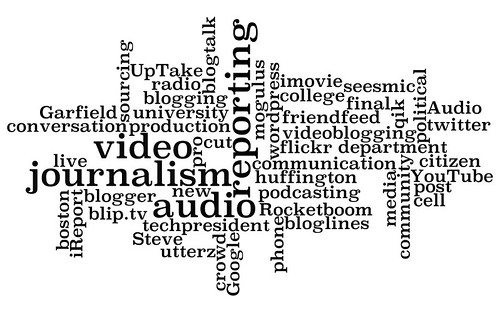
What does it take to be a multimedia journalist?
(Illustration: Steve Garfield)
I've had this discussion with a few people who currently practice in the general area that is "multimedia journalism." At the highest echelon, are you more journalist or programmer?The New York Times' multimedia team explains in the latest Ask the Newsroom:
Aron Philofer:
As for learning these skills, there's some disagreement among those on my team with formal computer science backgrounds on whether taking computer science classes is worthwhile. Some say college courses are often too theoretical, but others believe that even the theory provides a solid foundation for problem solving. I wouldn't know because, like several other members of my team, I'm entirely self-taught. So I'm living proof that it's possible to learn enough to write a few production Web applications, manage a development team and not crash NYTimes.com (yet).
Gabriel Dance:
What I see far too often in journalism schools, and I feel is a mistake, is the idea that somebody can just learn computer programming in a semester or two. Developing interactives and projects on the Internet requires a love of computers and a deep interest in technology. Most of the time, people develop these skills on their own, or pursue a technology-related career. If you really feel that you want to be a journalist-programmer, I encourage you to take some courses in the computer science department. It will give you the foundation that you just can't get by taking a couple of Flash courses.
Steve Duenes:
The journalist portion of the journalist/programmer combination shouldn't be neglected. We've had a number of strong technological performers pass through our department, and some of them had difficulty knowing which information to pursue or how to pursue it efficiently. Some had interesting ideas, but they weren't able to fully articulate what they wanted to do, and as a consequence, they were frustrated when we had to make decisions about which graphics to go after.I'm not saying that a master's degree in journalism is the thing to do. It might be. But the important thing is to find an environment where you'll be pushed and where you can grow. If you're surrounded by a few people with good experience and if your internship or job requires you to behave like a journalist, that's good.
From my experience -- self-taught but not extensively so, thus better than the average new media graduate but poorer than the average programmer -- a journalism grad with new media experience is no longer the desired employee for the leading online publications (like the Times). More often, it is the programmer who took a few journalism courses, rather than the other way around.
The good news is that means the bar is much higher now, ever rising, and stories can and will be told with such depth and nuance thanks to a team that has mastered the tools needed to express them.
The bad news is that a new media journalism graduate who wants to work in multimedia won't be able to at the highest levels without some serious coding expertise under his or her belt. In other words: perhaps a master's degree in computer science will do you more good than one in journalism.
Friday, January 16, 2009
Online, have rules of journalism ethics changed?
 A new post by Robert Miles on OJR.org analyzes the challenges print journalists face as they transition to the web -- specifically with regard to the assumptions they make regarding ethics and procedure.
The practice of journalism is an act of service. But if we are going to be able to continue to serve our audience, we will need to change some of the conventions and assumptions we've brought to our practice if they now stand in the way of our ability to serve. What good are conventions designed a generation ago to protected our public image if following them today leaves us with a shrinking audience and no advertisers to support us?
Miles takes three popular tenets of traditional journalism ethics that he believes journalists must change in order to remain relevant online:
- Old rule: You can't cover something in which you are personally involved.
- New rule: Tell your readers how you are involved and how that's shaped your reporting.
- Old rule: You must present all sides of a story, being fair to each.
- New rule: Report the truth and debunk the lies.
- Old rule: There must be a wall between advertising and editorial.
- New rule: Sell ads into ad space and report news in editorial space. And make sure to show the reader the difference.
It's clear that the op/ed beginnings of the blogosphere have affected journalism, and the debate's out as to whether that's for good or not. But writing standards and news cycles aside, it's clearly forced journalists to reconsider the rigid rules they were taught on the job or in school -- which I applaud. The old adage is, "if your mother says she loves you, check it out." So why do we take journalism's rules on face value?
With consideration to skepticism, why aren't we questioning our very journalism education?
Above, Miles clearly isn't suggesting that journalists change their core beliefs; rather, he's redefining how journalists can best empower readers with valid information. And I think we ought not follow journalism's rules with such religious fervor so much as follow journalism's intentions -- purpose, really -- with that same energy.
Monday, December 22, 2008
'Putting content on the Web would destroy our paper'
 In today's New York Times, Media Equation columnist David Carr explains the story of the TriCityNews of Monmouth County, N.J., who he says has prospered by shunning the Web entirely:
"Why would I put anything on the Web?” asked Dan Jacobson, the publisher and owner of the newspaper. “I don’t understand how putting content on the Web would do anything but help destroy our paper. Why should we give our readers any incentive whatsoever to not look at our content along with our advertisements, a large number of which are beautiful and cheap full-page ads?"Which, given the current state of media affairs, is a shocking pronouncement.
Carr elaborates on his column, describing a way of thinking that is best summed up as, "if it works, work it." He mentions John Koblin's New York Observer piece (perhaps this one, though Carr's article sadly and ironically doesn't link) describing how business magazine competitors Forbes, Portfolio and Fortune went through layoffs, with the Web getting hit the hardest. He mentions popular new media poster boy Nick Denton of Gawker Media, who predicted a 40 percent decline in Web display advertising.
Carr's solution in this week's media equation? "It's probably not a great time to be indexing into the Web either."
In other words, he doesn't really digest it at all.
David Carr is a smart guy. I've been lucky enough to meet the guy a few years back, before the book, back when the Carpetbagger was a new phenomenon.
But I don't think he quite solved this equation.
While his column is lean, and his space limited to explain nuance behind the situation, I really don't think he adequately explains the references he draws between very different types of publications. For example:
When it comes to brand advertising, print has a strong track record. Advertisers like the analog presentation in TriCityNews for the same reason they come back in droves to Vogue.
Well that's a real tough connection to draw. The TriCityNews is a local newspaper; Vogue is a national luxury fashion magazine. TriCityNews' advertisers are local and faithful; Vogue's advertisements are a part of a major campaign -- and when times are tough, luxury retailers pull back in a big way. Vogue has the advantage of being a glossy magazine, in which nearly nothing is "news" by any stretch of the imagination. And while I don't know anything about TriCityNews beyond the scope of this article, it seems to be a local neighborhood rag more for local interest than breaking news. And I suspect -- correct me if I'm wrong, Mr. Jacobsen -- that advertising doesn't fluctuate nearly as much as Vogue's, which, by the way, is often sold as an advertising package alongside sibling mags such as Glamour and W.
My point is this: To connect the lessons learned from this small publication that "the Web is to be avoided" to the larger media landscape -- even if only inadvertently implied by the very publication of Carr's article -- is to be misleading.
Let's look at some of the references:
The business magazines: All three mentioned are owned by major magazine houses (Forbes is Forbes, Portfolio is Conde Nast, Fortune is Time Inc.), and all three bring in luxury advertisers to a degree. Forbes has been in need of reinvention for awhile, and its website is hard on the eyes. Portfolio is a new magazine that never quite distinguished itself among the pack and whose publisher deliberately avoided investing online. Fortune is a Time flagship magazine but whose CNNMoney.com website is popular but woefully underused as a confusing catch-all pot for Money and Fortune's material.
Gawker Media: A collection of upstart blogs, Gawker is popular in major metropolitan areas (especially New York) but not much elsewhere. Gawker sites generally rely on being "first" in a string of reposting of news articles from other sources. Occasionally the sites have original commentary -- Denton himself contributes the site's most digested thought and Hamilton Nolan often comments just with his selection of stories -- but generally, it's a site that thrives on being the online trendsetter. Advertising has been experimental throughout the sites' lifetimes; Denton hasn't really settled on a system for more than a year's time and any sites that don't work from a financial standpoint are quickly spun off (Consumerist, Wonkette, etc.), no matter how popular.
The Wall Street Journal: Big media newspaper whose site, unlike almost all, including the Times, charges for most access. Paid subscriptions are up 7 percent from a year ago, and the implication is that with advertisements down, it's easier to get money from the readers themselves.
So my point is that it's unfair to lump together, even in passing reference, a family of breaking news and commentary bloga that exist only online, three magazines with different root problems (but the same financial symptoms) and a local city paper whose readership simply doesn't use the Web to read truly local news. Contrasting that with the sole exception in the news business -- the WSJ, whose rabidly loyal and wealthy readership continues to pay up front -- seems to be even more misleading.
(And for the record, when I want to read a Wall Street Journal article that's behind the pay wall, I just go without. The Times usually has a similar treatment to a story anyway.)
When you read any article, the first thing you should ask yourself is "why?" As in, "what is the point of this?" Usually, it's general interest, or news, or contextual.
I read this column looking for the big "So what?" and all I got were contradictory anecdotes. I didn't get an equation -- I got an expression.
Which may have been Carr's intent -- to say, look at this one publisher in the midst of others! But what I fear is that the lesson implied by the article is that the Web isn't quite the Holy Grail publishers should be chasing after. And for that, I disagree -- perhaps a tiny local paper need not use the Web (though having contact information and subscription information would be useful) for its news content, but all the other national publications must, just by their very nature.
To boot, I think the economy came a little to early in the print-to-Web transition, and with funds at risk, people are pulling back into something that's comfortable: the print business model. All of these publications, be it newspapers or magazines or online, have had 10 years or more to really sit down and think about the Web as a new business model. And yet so many have failed to think outside of the box. So it's a matter of confidence: when the money's at risk, they slash online staff, thinking that those readers and the staff that write for them are worth less to the publication. And that's true. But they're worth more to the brand and its future, and that's the misstep I see happening.
After all, if we're counting pennies, pixels are a lot cheaper than paper.
Thursday, November 13, 2008
Study: Huffington Post Favors Male Bloggers
Or, to put it another way, female bloggers are out of favor when it comes to appearing on the front pages of the massively-popular Huffington Post.
 Arianna Huffington.
In a fascinating study by Extra!, only 255 of 1,125 bylines, or 23 percent, of stories that appeared in the 13 "featured blog" slots on HuffPo's regularly-updated home page at a time belonged to women.
Extra! achieved these figures by recording featured bylines twice every weekday for nine weeks and coded them by gender. The study period lasted about two months, from 7/7/08 to 9/5/08.
More insight: Parity is scarce. Arianna Huffington, appearing 57 times, accounted for more than a fifth of all women's bylines; 45 of those occupied the most visible top post. Only once, in fact, did a woman other than Arianna Huffington get her byline in the most visible top slot—Post editor-at-large Nora Ephron.
Former HuffPoster Jessica Wakeman reports at Fairness and Accuracy in Reporting:
Which left me with some simple questions: I acknowledge the scarcity of women overall, but just how many of the Huffington Post's revolving stable of active bloggers are women? I'd be interested to know if there's parity when it comes to the flow of content coming in -- is the lack of women on the front page the result of editorial bias, or are there simply less women writing for HuffPo than men? (I don't have those answers, but I'd like to know more.) And if so, why?
Of course, if Huffington herself is wooing more female bloggers than male, than perhaps these numbers are indicative of something greater. But, as complicated as the Huffington Post site is, so is the ability to root this theory in data: is there gender parity within the politics section, clearly the favored section of HuffPo? Or does the imbalance of, say, "green" stories (and the writers who write them) perpetuate this problem on the site's penultimate front page?
(HuffPosters, if you're out there, I'd love to know.)
 Arianna Huffington.
In a fascinating study by Extra!, only 255 of 1,125 bylines, or 23 percent, of stories that appeared in the 13 "featured blog" slots on HuffPo's regularly-updated home page at a time belonged to women.
Extra! achieved these figures by recording featured bylines twice every weekday for nine weeks and coded them by gender. The study period lasted about two months, from 7/7/08 to 9/5/08.
More insight: Parity is scarce. Arianna Huffington, appearing 57 times, accounted for more than a fifth of all women's bylines; 45 of those occupied the most visible top post. Only once, in fact, did a woman other than Arianna Huffington get her byline in the most visible top slot—Post editor-at-large Nora Ephron.
Former HuffPoster Jessica Wakeman reports at Fairness and Accuracy in Reporting:
Women's voices have long been lacking in corporate media. As Internet outlets compete more and more with traditional media as a source for news and opinion, will women's voices be heard there more frequently than in print publications? If the Huffington Post, one of the most prominent and successful blogs today, is an accurate barometer, the answer is no. [...]
While the Huffington Post provides an outlet for certain voices that seldom make it into the corporate media, it falls perfectly in line with elite print media's abysmal gender numbers. In Extra!'s 2005 op-ed study (5–6/05) of major newspapers and magazines, U.S. News & World Report led magazines with a still-dismal 28 percent of op-eds penned by women, followed by Newsweek at 23 percent and Time at 13 percent. Newspapers fared even worse: Women's bylines appeared on 20 percent of op-eds in the Los Angeles Times, 17 percent in the New York Times and 10 percent in the Washington Post. For syndicated columnists, the numbers were likewise low, with women writing 24 percent of columns at the eight major syndicates (Editor & Publisher, 3/15/05)—which still beats the Huffington Post.
Which left me with some simple questions: I acknowledge the scarcity of women overall, but just how many of the Huffington Post's revolving stable of active bloggers are women? I'd be interested to know if there's parity when it comes to the flow of content coming in -- is the lack of women on the front page the result of editorial bias, or are there simply less women writing for HuffPo than men? (I don't have those answers, but I'd like to know more.) And if so, why?
Of course, if Huffington herself is wooing more female bloggers than male, than perhaps these numbers are indicative of something greater. But, as complicated as the Huffington Post site is, so is the ability to root this theory in data: is there gender parity within the politics section, clearly the favored section of HuffPo? Or does the imbalance of, say, "green" stories (and the writers who write them) perpetuate this problem on the site's penultimate front page?
(HuffPosters, if you're out there, I'd love to know.)
Wednesday, November 12, 2008
Nick Denton: 'Flat Is The New Up? We Should Be So Lucky'
Gawker Media head Nick Denton has a lot to say about this recession we're in, and much of it is worrisome.

A concise, backed-up take on what Denton thinks is going to happen to Online Media in coming quarters:
His Machiavellian take to online publishers? Plan for the worst - now. How? Six ways:
Read the post: Doom-mongering: A 2009 Internet media plan

A concise, backed-up take on what Denton thinks is going to happen to Online Media in coming quarters:
To judge from a hysterical press, one might think the apocalypse was already upon the media industry: rolling cuts this month at Time Inc., the hallowed magazine group; a new catchphrase among advertising pundits, flat is the new up; and revisions even of the internet advertising that was supposed to be the salvation of the media industry. J.P. Morgan's Imran Kahn just slashed projected growth next year of US online display advertising from 16% to 6%.
We should be so lucky. These supposedly brutal layoffs at Time and other titles amount to only 6% of headcount at the bloated Time Warner magazine group. Other media groups such as the New York Times and Conde Nast—a hiring freeze, how callous!—are being even more squeamish. From conglomerates to internet ventures, executives should be planning now on a decline of up to 40% in advertising spending during this cycle. Instead they're sleepwalking into economic extinction—even those lean online ventures which were supposed to take up the mantle and preserve New York's position as a media capital.
His Machiavellian take to online publishers? Plan for the worst - now. How? Six ways:
- Get out of ad-averse topics like politics
- Renegotiate vendor contracts
- Consolidate titles
- Offshore more
- Variable compensation
- Offer more value for marketers
Read the post: Doom-mongering: A 2009 Internet media plan
Tuesday, November 04, 2008
Digital Front Pages: Obama Elected President of the United States of America
When there's a historic moment, people like to chronicle the front pages of newspapers from the next day. But in this day and age, I thought the digital front pages of news organizations would be far more interesting, snapped moments after the big story broke. Here's how some of the most popular news outlets in the world handled the story, "Obama Elected President of the United States of America."
See how each handles the gravity of the story:
The New York Times:

Wall Street Journal:

USA Today:

Los Angeles Times:

Washington Post:

Chicago Tribune:

Chicago Sun-Times:

New York Daily News:

New York Post:

Boston Globe:

Philadelphia Inquirer:

Atlanta Journal-Constitution:

Houston Chronicle:

Minneapolis Star-Tribune:

San Francisco Chronicle:

Detroit Free Press:

New York Newsday:

Anchorage Daily News:

CNN:

ABC:

CBS:

NBC:

FOX:

The Huffington Post:

New York Magazine:

Le Monde (France):

La Reppublicca (Italy):

The Guardian (U.K.)

Truly fascinating.
See how each handles the gravity of the story:
The New York Times:

Wall Street Journal:

USA Today:

Los Angeles Times:

Washington Post:

Chicago Tribune:

Chicago Sun-Times:

New York Daily News:

New York Post:

Boston Globe:

Philadelphia Inquirer:

Atlanta Journal-Constitution:

Houston Chronicle:

Minneapolis Star-Tribune:

San Francisco Chronicle:

Detroit Free Press:

New York Newsday:

Anchorage Daily News:

CNN:

ABC:

CBS:

NBC:

FOX:

The Huffington Post:

New York Magazine:

Le Monde (France):

La Reppublicca (Italy):

The Guardian (U.K.)

Truly fascinating.
Subscribe to:
Posts (Atom)


![Editorialiste [at] gmail](https://blogger.googleusercontent.com/img/b/R29vZ2xl/AVvXsEjzDvlHqUd5msfCmRq2Q5EZRpn_nbVg33bjiUhLEigM_5fudZhIHvuAVxB4_MS0xn-cQ0EKyjxOua1ysQ4NdMzyvhg1oSVTv6OJAarhVTqG0BBkJKTjqBhwMjrMGOANWxT8l8rKFg/s220/editorialiste_logo.jpg)