Showing posts with label journalism school. Show all posts

Wednesday, March 11, 2009

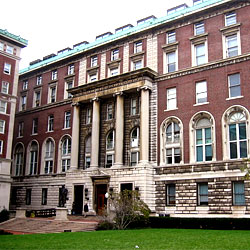
A word about Columbia J-School's 'Existential Crisis'

Former New York Sun editor Erica Orden wrote an interesting post today on New York magazine's Daily Intel blog entitled "Columbia J-School’s Existential Crisis," detailing the difficulties that the school is having adjusting to what it calls a "new media mindset."

Orden writes:

The media bloodbath hasn’t made for happy days at Columbia Journalism School. When the Times recently announced that its new, hyperlocal blog experiment “The Local” would be assisted by journalism students not from Columbia but from the City University of New York, you could practically hear the collective gasp echoing in the hallowed halls uptown. CUNY? Since when does CUNY trump Columbia? Well, since digital journalism became the single ray of hope on an otherwise dark media horizon, and Columbia’s vaunted ability to train students as print reporters began to appear obsolete. And so the school is trying to change. Fast.
To back up that statement, Orden notes the arrival of Bill Grueskin, former managing editor of WSJ.com, and the upcoming change in curriculum to focus more on digital endeavors -- which has, according to Orden, "raised the ire of some professors, particularly those closely tied to Columbia’s crown jewel, RW1."

“Fuck new media,” the coordinator of the RW1 program, Ari Goldman, said to his RW1 students on their first day of class, according to one student. Goldman, a former Times reporter and sixteen-year veteran RW1 professor, described new-media training as “playing with toys,” according to another student, and characterized the digital movement as “an experimentation in gadgetry.”

Orden goes on, accurately and with great detail, as to the "zero-sum" struggle of new media vs. old media resources; of hiring professors who know the former better than the latter and training those who know the latter and not the former.

Orden details the struggle at Columbia deftly:

Part of the problem is the perception that the situation is a “a zero-sum game,” as one person put it, where adding lessons in video production or law for bloggers will dilute or displace the school’s long-heralded focus on journalism’s core precepts: concise prose, ethical reporting, and sophisticated editorial sensibilities.

But the hurdles are practical as well as philosophical. Because many of the tenured professors haven’t worked in new media themselves, their classes require the addition of tech-savvy adjuncts, which has Lemann worried about “blowing out the budget.”

Orden wraps up the story with a sentiment I think all of us can agree on: that the real issue isn’t whether j-schools can afford to change, but that they can’t afford not to.

I believe this article reveals, faithfully, the administrative and honest struggle that journalism schools are having coping with a sudden rush of new media. The temptation to "dive in" headfirst without figuring out how to apply it, or without looking at return on investment for new storytelling methods. The struggle to convince "old media" journalism professors that new media is worthwhile, and vice-versa. 

It's a game of politics, but I think everyone is equally concerned for the same reasons: j-schools must continue cranking out the best journalists. But how?

I believe this article is framed incorrectly, however. The meat of the article is accurate, but the lede and the style used to make the point is misleading.

I've written before about my experience in the new media program at Columbia, and I mean in no way to be an apologist or defender of Orden's claims about the school. But I feel the obligation to clarify some of her inferences about and references to the school using the reality I experienced there.

  • The CUNY vs. Columbia "slight" in the lede is a creative way to play off Columbia's establishment position as the training ground for the New York Times, but Orden infers, without directly saying so, that Columbia has suddenly snapped out of its print mindset to catch up to the new media forerunners. 

    That's simply not true. The new media program has existed at Columbia, albeit in a much smaller form, since the 1990s. Much of its development is thanks to chief new media evangelist (and dean of students) Sree Sreenivasan, who has taught at the school since 1993. The program has evolved over time with the technology it covers, and has in recent years seen a noticeable bump in students who apply for the "new media" program. So it seems to me that the program has changed to address student demands, rather than trends in journalism directly.

  • Secondly, Orden credits Grueskin with that change, who arrived on June 4, 2008. I don't know firsthand just how much Grueskin has contributed behind the scenes. What I can say, however, is that the curriculum change for new media students was in the works long before he arrived, because Sreenivasan showed us a working draft of it sometime late that spring. 

  • As for RW1 -- Columbia's core reporting class, the nuts and bolts course -- Columbia "webified" the course for the first time for the school year 2007-2008, adding a content management system so that students could post their stories. Many of the difficulties Orden details about convincing old-time professors certainly do exist. However, Orden singles out one professor as an example of the skepticism -- and I must take issue with that. 

    I had the pleasure of taking a course from the professor that was singled out, and we produced a fine website for the class. In no way was my imagination limited by the professor with regard to that site. It's true that several professors at Columbia are new media tone deaf. And why should they be anything different? Some of them, particularly those of an advanced age, don't have a perceived need to be trained in new media. But that's not to say they aren't receptive to using it, even if they don't understand how to do it. 

    What's more, to debunk one of my own points, some of the oldest professors at Columbia are actively involved in the new media program. And I think that shows a lot of heart and willingness to learn, if nothing more.

  • Finally -- and most notably for Orden's lede -- the new media coordinator that she quotes was, prior to taking a full-time position at Columbia this past May, a new media adjunct at both CUNY Graduate School of Journalism and Columbia. For someone trying to start a new media war in her lede, that's a serious omission -- as are the other adjuncts who pull double-duty at both schools.

But Orden knows that -- she graduated from Columbia's j-school in 2006.

Still, I think the takeaway from Orden's post is far more valuable than the clarification I attempted to provide above. In every journalism school -- like as in every printed publication -- there's a generational, fight-or-flight, ROI-questioning debate about the place and weight with which we should approach new media and the storytelling techniques it provides. 

And for that reason, I believe we're all in this together -- it's not at all a race to be the "new media" king. Especially if the publications at the bleeding edge of adopting new media prefer computer science grads to journalism grads

Among j-school grads, I believe there's a kinship, a knowing bond that has developed from being in the experimental incubator together -- be it in New York, Missouri, California or Illinois (or Arizona, or Ohio, or...). From what I've seen, no one knows the answer to the great "new media" question -- especially j-schools. That's because the publications the schools are supposed to prepare their students for don't know, either. 

I don't want to appear as though I look through rosy lenses -- I have my criticisms of the journalism programs I have graduated from. But they seem to be far more prepared to handle the change than most of the publications I've worked for.

The policy is that there is no policy. As a journalist, I think that's wildly exciting.

UPDATE: Via Twitter, NYU's Jay Rosen directed me toward these meeting minutes from an NYU journalism school think session. It's a revealing look into what journalism educators are grappling with at this moment.

Monday, September 29, 2008

Journalism As An Elite Profession? Not According To Steve Dunleavy

Longtime New York Post-man Steve Dunleavy on journalism:

“When I first came around, there was some very good newspapermen in New York,” Dunleavy said. “But increasingly, they started leaning on this Columbia School of Journalism thing. That you wanted your mom to be proud. That it was a profession.

"Journalism is a craft, like being a master plumber. We wore white collars, but we were blue collar.”


Is this the same today? (Personally, I don't think so.) Discuss.

Monday, September 08, 2008

Hard Copies of Newspapers, and the State of Journalism at NYU.

Is New York University behind the times in journalism education?

NYU student Alana Taylor made journalism news headlines last week with an interesting missive on PBS MediaShift about the journalism program at the university, once referred to merely as the "Department of Journalism" at NYU and now branded as the "Arthur L. Carter Journalism Institute" at NYU (with revamped curriculum to match), by stating that, in so many words, the NYU journalism curriculum doesn't serve the new media needs of a Generation Y student.

An undergraduate at NYU, Taylor blasts the paper-only mindset of the school, lamenting that she has to bring a hard copy of the New York Times with her to class, among other old-media, MSM things. The reaction around the journalistic blogosphere, acute and forceful, turned the barrel back on her for complaining. "You are wrong," "back to the NY Times," "learn how to write news" and "take some classes" were among the responses, criticizing her for being critical and generally missing her point entirely.

Well, this whole thing is not about her. It's about NYU.

A card-carrying Gen-Y'er, I found my love for journalism at NYU as an undergraduate, like Taylor. But when I attended, the curriculum was ad hoc at best, lenient and directionless with no ultimate goal. Had I not joined the school paper, the Washington Square News, I would never have been able to truly flex my journalistic muscle -- albeit in the old-style way, as in hard news -- nor befriend people on the same path, since the NYU journalism department was one of the largest majors at the university while I attended. My classes generally did not account for the computer as anything more than a tool for research. To most, it was not a publishing platform.

But, as evidenced in Taylor's description, NYU journalism is much better off than when I attended just two years ago. Yet it's clearly still not up to par.

Like Taylor, I'm new media-inclined, and I, too, blogged and "plugged in" as part of my journalistic experience there, mostly outside of class. I, too, complained about bringing a hard copy of the Times to class, because I read it online.

So, with all the "convergent" changes NYU has made, it is a valuable critique that the department's -- sorry, institute's -- new media instruction pales to the competition. Sure, Taylor is an undergraduate, and that group in particular receives far less specific training than the graduate level.

But when I attended NYU, the only new media class I took was called, amusingly, "digital journalism" -- and it was a blog-focused affair that looked at the ethics, practices, writing style and issues of online news and opinion taught by the affable Patrick Phillips, of I Want Media (another was taught by the media storm of a man that is Jay Rosen). And this was all in 2006.

So, in two years -- light years for the Internet, and just look at any webpage from 2006 to see it -- NYU's new media outlook hasn't changed that much. It's lamentable.

I was lucky enough to attend Columbia's Graduate School of Journalism after NYU, for new media. And one of the reasons I attended was to do everything I wasn't able to only had a taste of as an undergraduate at NYU. Video, audio, interactive design, blogging -- that was something I used to do in my spare time. At Columbia, I did it for my degree. At NYU, it was a grand experiment in an entire class blogging.

NYU's undergraduates either study "general and investigative reporting" or "media criticism," and graduates study one of 10 subject-related fields. Columbia's M.S. graduates study "print," "broadcast," "magazine" or "new media," and it's M.A. graduates delve into the subject-specific matter.

I don't intend to compare NYU's undergraduate curriculum with Columbia's graduate instruction as apples-to-apples. I merely want to show how radically different an experience can be in just one year's time, from one school to the next. How different an approach to journalism education can be with regard to categories.

Categories or not, Taylor's taking to the challenge by learning on her own, like I did. Good for her, I say. She knows she's ahead of the curve anyway, and she's getting an education by learning what she doesn't like.

So why is NYU behind? Allow me to posture. From what I've seen as a student, lots of staff changes in recent years, with a revamped curriculum (undergrad and grad) and a new building entirely. NYU's journalism school is a department within the greater College of Arts and Science, so it does not have the dedicated resources that it would if it were a separate school, instead bureaucratic red tape and a lack of funds. The department's never had much of an identity (a "department" is now "the institute," which helps greatly) and, given its size, hardly any community at all, with a serious lack of alumni relations (and I mean no disservice to the single alumni coordinator).

I was speaking with a former editor-in-chief of WSN, and we agreed that, had we not joined the paper, which is (was) not promoted by the department at all, we would never have made journalism student friends. Which is hard to believe, since j-students are a tight-knit, give-a-helping-hand group of professionals. When I simultaneously created NYU and Columbia journalism groups on LinkedIn, the popular networking site, the "join rate" of Columbia's dwarfed NYU's, even though Columbia is a much smaller program and lacks undergraduates entirely. (To date, Columbia's has 130 members, while NYU's a paltry 24).

The reason I say all this is because NYU's journalism program is in the midst of profound change -- much like the kind of change newspapers are going through all over the country, one of identity and mission. The department is turning a corner, slowly, but it remains to be seen if Taylor's concerns about new media are a part of the new direction of the department. Perhaps there is no reliable system of feedback for its own, many, graduates. Sure, NYU now has great new facilities for such instruction, but is it actually a part of the practical, bootstrap, nuts-and-bolts instruction? Apparently not, according to Taylor. And that's a real shame, because there exists few journalists in this world that don't have digital copies of their clips these days.

I don't fault anyone for not knowing Mashable -- as popular as it is, it's easy to miss. But to not account for a journalism student's desire to eventually write for the web -- and not a paper, or magazine, etc. -- that's bad news in my book.

Oh, and you know what, Alana? In all my time at NYU and Columbia, I've only read a paper New York Times twice (I read it several times a day online). Both times, NYU professors were "to blame." But I'm happy I had to, just those couple of times. It's easy to forget how some people read the news.

But there's a vice-versa to that, too.

(Much thanks to Lam Vo and Simon Owens at Bloggasm for the heads-up on this.)

Monday, August 25, 2008

Cronkite J-School Enters 'Bar Room Brawl' With Medill, Columbia, Missouri

I recently read an interesting article about the kickoff for Arizona State University's Cronkite School of Journalism and Mass Communications [sic], which is apparently aiming for the "Top Five" j-schools in the country:

To journalists, the names are familiar: Medill, at Northwestern . . . Missouri . . . Columbia . . . Syracuse . . . Scripps, at Ohio University.

These schools and one or two others long have constituted the benchmarks for journalism education in the Unite States. Get accepted at one of these demanding institutions and you can count on a cutting-edge education in modern American journalism.

Now, the Walter Cronkite School of Journalism and Mass Communications at Arizona State University seeks entry into the club. And its advocates are not shy about saying so.


Some interesting things come from this. First, Arizona Republic writer Doug MacEachern explicitly defines the Top 5 j-schools -- the top stratum, really -- as Columbia, Medill, Missouri, Scripps and Syracuse, in alphabetical order. (No word on where, if any, MacEachern went to school.)

Even more interesting is his willingness to draw differentiating lines between the programs:

For good reason, Columbia and Scripps are perceived as incubators of writing technique. Syracuse is a great "reporter's school." And Medill and Missouri are renowned for graduate programs that have produced many (if not most) of the nation's top news editors.

I'm not sure how accurate these are -- we'd probably have to convene a panel of experts to get to the truth, and some of these overlap -- but it's probably the first time that I've ever seen such distinction drawn in print. (...ironically.)

So, then, what will Cronkite be known for? It's not clear at this point. But as I mentioned before, we could use some j-school rankings to figure it all out. Or at least know that journalism can thrive in dusty Arizona.

P.S. - What happened to UC Berkeley j-school?

Tuesday, June 17, 2008

Is J-School Worth It? (The Answer May Surprise You)

The most recurring question asked of me in the last month since I graduated from the Columbia University Graduate School of Journalism is simply: "Was it worth it?"

It's a great question to ask, because there are so many conflicting statements out there, especially on the Web.

For example:

Will j-school eat your brain? ("J-school ate my brain," Michael Lewis, The New Republic, July 1993)

Will j-school become a necessary credential for a job? ("Can j-school be saved?" Jack Shafer, Slate, Oct. 7, 2002)

Is j-school a cakewalk? ("The trouble with j-school," John Buchel)

Will j-school destroy your finances? ("The $19,000 press pass -- a former journalism school dean asks, is it worth it?" Carolyn Lewis, Washington Monthly, May 1986)

Is j-school full of Woodward and Bernstein hopefuls? ("Deep Throat, J-school, and Newsroom Religion," Jay Rosen, PressThink, June 5, 2005)

Will j-school ruin unrealistic expectations? ("Off the fence," Katia Bachko, Mediabistro J-School Confidential, Aug. 3, 2007)

Is it only for grads and not undergrads? ("Do you need a graduate degree in journalism?" Walden Siew, JournalismJobs.com)

Is it for the science of trade or the theory of media? ("The j-school debate," William A. Babcock, Christian Science Monitor, Aug. 1, 2002)

Is j-school choosing the establishment? ("An open letter to j-school grads," Greg Lindsay, Mediabistro, May 24, 2005)

Is it, quite simply, inane 'journalismism'? ("J-school scandal is inane as j-school itself," Hamilton Nolan, Gawker, Feb. 21, 2008)

Is there a payoff at the end of it? ("Is j-school worth it?" Kevin Whitelaw, U.S. News & World Report, Mar. 10, 1996)

Should it even exist? ("Should j-school even exist?" Andrew Nusca, The Editorialiste, Oct. 3, 2006)

Which j-school is the right one? ("Searching for the perfect j-school," Brent Cunningham, Columbia Journalism Review, 2002)

Is it all a myth? ("Getting it wrong for 16 years (at least)," Reese Cleghorn, American Journalism Review, June 1993)

And of course, is it worth it? ("Is journalism school worth it?" Rachel Deahl, About.com Media Careers)


OK, ok, so you get the point. With each question, you can really see the fever pitch of this discussion.

The reason I chose to put all those links above is to illustrate just how conflicted the whole conversation is -- and how diverse the opinions can be, be it from j-school grads or journalists without degrees or people wholly unaffiliated with journalism altogether.

Compounding the problem is a lack of a reference point -- there isn't even a centralized list of journalism programs and schools in the United States (despite Editor & Publisher's best efforts), much less an explanation for which programs are for communications, which are for bootstrap newspaper reporting and which are Web-ready. Hell, there aren't even rankings anymore -- nothing to tell you what makes Columbia, Medill, Missouri or Berkley any different from E.W. Scripps, NYU, CUNY, Syracuse, Texas, or Arizona.

But I digress. So is it worth it?

It's a personal decision, of course, but for me, it's been worth it. And I say this coming from the point of someone who owns not only one, but two journalism degrees -- one as an undergraduate, and another as a graduate.

So what's the deal? Why did I go to j-school -- after I went to j-school?

Allow me to use a food metaphor.

An undergraduate experience of journalism is like eating a piece of cake. You learn that cake tastes good, sweet -- it helps you decide that yes, you like cake -- maybe even more than you like any other desserts. But you haven't tasted all the different kinds of cake in the world, and no one's forcing you, so you'll spend much of your undergraduate experience eating all sorts of other tasty desserts -- cookies, ice cream, popsicles, whatever -- some for the first time, some not.

As an undergraduate, you probably spent 25 percent or less of your time practicing journalism. You're too busy growing up, learning about other things like Plato and statistics and Proust, to really have done journalism all day long. That's the point -- liberal arts, are, well, liberal in your experience. I didn't choose my undergraduate university for journalism -- I chose it for its large offerings and its location, which I think is more important than anything. I only discovered journalism later. By the end, you might think, "hey, I can be a journalist when I graduate," but most you probably of aren't thinking that with conviction. A real job will probably affirm that for you, which I can attest to after seeing some of my friends flourish and some reevaluate their direction post-graduation.

The graduate experience of journalism is like going to a cake tasting with hundreds of flavors of cake. You get to try all different kinds of cake -- chocolate, pineapple, red velvet, carrot, and hey, they might even teach you how to bake one -- and you're eating cake all the time, every day. You probably chose graduate j-school because either you really, really like cake, or you used to really, really like cookies until you had to eat them full-time (in which case you thought, "hey, I think I could eat cake full-time," and defected).

Graduate j-school is journalism, all day, every day. All of your classes are journalism, and you're surrounded by other journalism people who are moving down that same highway. They might be broadcast, they might be print, they might be new media -- but they're all thinking, "I like journalism," certainly enough to pay beaucoup bucks for it.

I went to journalism school to have the experience of being surrounded by these people. As an undergrad, I didn't have that same sense of community, that same feeling that we're all in it together (not all schools are this way -- I just happen to have gone to a school that thrives on individuality). Yes, it's nice to have an advanced degree to be recognized, to put "master's" on the old resume, to have a venerable institution's name on my wall. There is no one who can deny the appeal of that, if only a little. But I went because of the people.

At first, this doesn't make a whole lot of sense -- why would I go for the people? I already had clips and internships under my belt from undergrad. But I went so that this environment could push me to do the things I didn't have time to do as an undergrad -- and foresaw not having the time to do as a professional.

J-school bought me time. In my case, it bought me exactly one year to write, record, design and edit the longest, most thoroughly-reported, most multimedia-infused stories I could.

I went to Columbia as a "new media" major, because for me, filing stories digitally, taking pictures and posting them online is the norm. It's my "print" track, so to speak. My time at graduate j-school allowed me to spend six straight months -- save for classes, that's the truth -- sitting in front of my computer and learning Adobe Dreamweaver, Flash, Photoshop, Final Cut Pro, Soundslides, Audacity, how to shoot in HD-DV, how to shoot with a digital SLR, the techniques behind all that and most importantly, when (if at all) to use it, and how.

And that's something that I simply would not have had time to do as a full-time employee straight from undergrad.

Now, most of you aren't going to go down the new media road, but the lessons are the same. If there are things you want to do journalistically that you haven't had time to do elsewhere -- write a 3,000-word magazine feature, or craft a book proposal, or spend time practicing at pitching freelance pieces -- j-school is that safety net. It's a safety net made of your tuition dollars, of course, but the way I look at it, those tends of thousands of dollars are you buying yourself time to learn what you didn't know before.

Journalism school might teach you a little, but those who succeed in it are the ones that teach themselves even more. In other words: what you directly learn from classes is 33 percent of your journalism education.

The other 66 percent is getting a freelance pitch accepted or rejected, working all night against deadline, blowing a deadline, misquoting a source, quoting a source correctly and having that person remain unhappy with what they said, blowing past a word limit, being assigned the task of editing your own story, working with another reporter as green as you are on an assignment, and so on. J-school is one or two years of you buying yourself the time to do all of this. You're effectively putting a price tag on that experience, and last time I checked, it can run as high as $65,000.

Of course, this is why j-schools naysayers have such a strong argument: after all, much of this can be done in the real world, of course, as an employee at a paper or magazine. They call it "learning the ropes." And they're right. That's why you start at a smaller-sized, less-reputable paper with less education -- you can take risks there, and the stock market won't fall because you accidentally misquoted that Wall Street analyst on JPMorgan's earnings because you couldn't read your handwriting in your Moleskine.

But that's why you've been assigned to cover the community board anyway.

What j-school does is partially re-enacts that atmosphere, with added time for discussion and feedback and experimentation and with less threat of a libel lawsuit and career-damaging missteps. So instead of being locked onto the crime beat, you get to report on crime, science, race relations, politics, business, fashion, art, education and so forth. Plus you learn some journalism history, you discuss ethics, surrounded by peers in the same mindset and instructors and mentors with seasoned wisdom, and you think about what the hell the whole thing means besides the aforementioned $65,000.

So is j-school worth 65 grand? I honestly don't think very much is worth 65 grand anyway. A Mercedes isn't worth 65 grand, nice as it is. So is j-school worth it -- "it" being "worth going"?

Yes. If you have the conviction to challenge yourself and learn from the personal experiences that result from that, then yes, I'd say so -- whether you end up a journalist or not.

Will it guarantee you a job? Nothing can. (And as more and more people go to journalism school -- thus guiding it toward that prerequisite credential Jack Shafer is afraid of -- it will mean less and less on the surface, as a line on your resume.) But the same kind of drive that gets you through it is the same kind of drive that gets you the job.

Of course, with personal drive like that, the naysayers would simply say that you don't need j-school in the first place. And they've got a point. But didn't you say you wanted to go to j-school?

Then why should it matter?

Tuesday, April 29, 2008

NYT's Bill Keller: Yes, J-Schools Matter

Some fascinating quotes from the conference, “Crisis in News: Symposium on Investigative Reporting,” at UC Berkeley’s Graduate School of Journalism, for all of you who read "J-school Ate My Brain" and became depressed:

"We’ve come to take journalism schools more seriously. [audience laughs] No, we used to hire people according to clips and the academic background isn’t as important. I didn’t go to journalism school, there used to be a grizzled editor who would help young reporters figure it out, but those grizzled editors are gone now so the schools are more important." -- Bill Keller, executive editor, New York Times (emphasis added)

So the times are indeed changing -- and maybe all of that advice about how "you don't need j-school" isn't applicable to the 21st century. Keller's word isn't the final word, of course, but it's an especially prominent and accomplished one. If Keller's feeling the effects from on high, who knows what the situation really is.

On more interesting quote on that note:

"There used to be more beginning positions at newspapers and smaller magazines have scaled down their staff jobs. All these places that feed the Pulitzer winners at bigger papers — those sources are drying up, and I find that worrisome." -- Clara Jeffery, Mother Jones


The "intelligence flow" or "talent flow" of journalism outlets is changing, it seems.

Thursday, January 17, 2008

Journalism A Hot Commodity In Higher Education

So I'm sitting at home watching some post-dinner television when I see a commercial trumpeting "digital journalism" on my screen.

"Learn digital journalism at the New York Film Academy," it told me. "Versatility. Curiosity. Is this you?"

Hot on the heels of the newly-created City University of New York's Journalism School, the New York Film Academy has linked up with NBC to offer this program within their filmmaking section, and it was quite an interesting approach.

Indeed, here is a specialty arts school taking on the craft of journalism to teach, rather than a specialty journalism school taking on the craft of filmmaking (or audio manipulation, or web design, and so forth). And I hadn't heard about it until just now.

The program details are listed here if you scroll down, or download this PDF. And it makes me wonder -- what were the challenges in designing such a program in a non-j-school setting?

Either way, this program's existence leads me to think that all the journalism programs in New York should get together for one big industry pow-wow and screen their students' work. Wouldn't that be an interesting night?

The "next generation journalist" now has Columbia, NYU, CUNY and NYFA to choose from. A lucrative profession? Maybe, maybe not. But a lucrative academic program? Seems so.

Monday, October 22, 2007

Using Your Journalism Degree To Name The School You Got It From

Man, is it just me or is this flap over Medill's name stupid?

(If you've missed it, Medill School of Journalism -- the first in the nation -- is
exploring a name change, "to better represent the school and what it offers." Romenesko's comments lit up with the possibilities.)

I try to keep the topics on this blog to be more serious in nature, but the more I read about this, the more I think -- man, this is stupid, stupid stuff. There are 101 things wrong in the journalism world, and here we are worrying about a name. It's kind of like George Bush forming a committee to rename the White House while we're in the middle of the war in Iraq.

Talk about priorities.

My undergraduate alma mater, New York University, did the same thing to its school of education. The former "Steinhardt School of Education" -- which housed classes in classical music, education, communications, and more -- into the "Steinhardt School of Culture, Education, and Human Development," which is not only a mouthful, but shows the poor organization of a university that already has a College of Arts and Science and shows the poor initiative in naming a school after what basic skills all universities should offer: culture, education, and (hopefully), human development.

So, I ask this, the future "Medill School of Journalism and Integrated Marketing Communication": Do you really want to be the next Steinhardt?

Reactions have already been posted by students on the Daily Northwestern and faculty in conspicuous places, and it's not good. Reading them got me thinking: OK, so Medill wants to change what journalism means in the 21st century. Got it -- and we can debate whether marketing should enter journalism in another discussion. But does all that require a name-change, too?

Can't we just redefine what journalism is? Isn't it already being redefined as we speak?

It appears to me that Medill is losing focus -- and apparently, judging by Nancy Schwerzler's comments linked above, losing graduates to law school, too.

There's always been the push-pull of being in the journalism industry, but it's starting to seem as if Medill's moves are pushing the focused journalists out and in the process, making the degree irrelevant.

Journalists are already jacks-of-all-trades. That's largely what "journalism" is defined by. Do we really need a $40,000 piece of paper that expresses that, too?

Friday, July 20, 2007

Editorialiste Presses On Hold For One Week

The Editorialiste will be on break for the following week and will resume July 31.

Until then, keep an eye out...the storm's a brewin' for journalism school...

Oh, and CNN runs a feature story on its own employee...

--The Edit.