
Slate's Jack Shafer, ever a favorite read of mine, trashes
Al Gore and Tom Friedman this week for blaming
celebrities as the reason why the nation can't seem to focus on the real issues, like immigration.
"Britney and K-Fed and Anna Nicole Smith and all this stuff, meanwhile, very quietly, our country has been making some very serious mistakes that could be avoided if we the people, including the news media, are involved in a full and vigorous discussion of what our choices are," Gore said earlier this week on Good Morning America.
Shafer puts forth some evidence saying otherwise, with which I agree: "By my back-of-the envelope estimate, your average big-city daily carries more news about immigration (or other significant issue du jour) in one day than it does about every celebrity on the planet in a full week."
What I don't agree with is in the next graf:
"If he possessed any real courage in his conviction that news coverage of the frivolous blocks the discussion of serious "issues," he'd attack sports coverage. Sports capture a billion times the attention that celebrities do and probably swallow 20 percent of the news budget of dailies. The reason Gore gives sports coverage a bye while castigating Britney coverage is simple: Sports fans talk back—loudly—and folks who crave entertainment-news coverage are too embarrassed to defend their innocent diversion."
Similarly, Shafer goes on to criticize Friedman for suggesting that we put 9/11 and Iraq behind us so we can debate more important issues.
And I think all of this is
baloney.
As silly as it is for Gore to suggest that the "gossiptainment" coverage steals our national attention, I really think that he didn't mean it quite so literally, and that he was just looking for a contrasting scapegoat. After all, you've got to have a feel for the popular opinion, and I'm pretty sure Paris Hilton is much more interesting to the average American reader than, say, a heady New York Times piece on Iraq.
So to suggest sports? Well sure, Shafer's got a valid point that it takes up just as much of our attention as celebrities do, but I think he's avoiding making a more serious point at the expense of some humor -- the fact that
the ongoing political coverage in Iraq simply doesn't resonate with the average American (who doesn't have a sibling or child in the war). If it doesn't resonate, there won't be a reaction, which is why the average American has probably put more thought into their vote for "Dancing with the Stars" than any recent story on U.S. foreign policy.
It's called "foreign" policy for a reason -- and most Americans see it that way. So to blame sports, those epic, domestic battles that make daily living easier? Come on. Apples and oranges. This isn't a media question, this is a question about the psychology of Americans. The papers just reflect that.
So what would you prefer? A press that reflects its readership or one that sets agendas? Ideally, a publication should only reflect its readership, but we all know that's close to impossible.
So really, I think
Shafer ran with the humor in his latest column at the expense of identifying a problem that's been mentioned before -- the disconnect between pressing national issues and the American people -- but never really solved. Shafer mentions Vietnam as a point of contrast ("Yet during the Vietnam era, the public and politicians found time and space to squabble over civil rights, the environment, Medicare, and missile defense, just to name a few topics"), but the real difference is somehow Iraq doesn't quite get everyone so frustrated. And I think we agree that it should.
So who's really to blame?
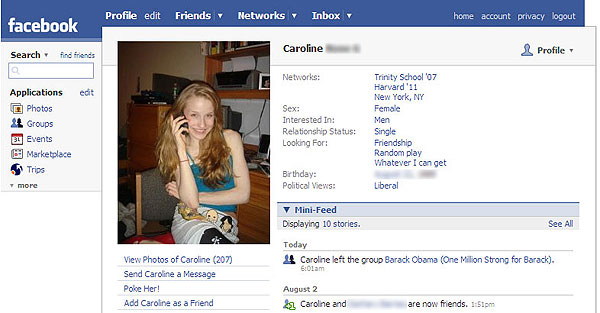 These questions came to mind when I saw Slate's recent post about Caroline Giuliani, who was a member of a Barack Obama support group on the social networking site Facebook. I don't know about you, but many questions are raised, and I spent most of the wee hours asking them over at IvyGate. So in the spirit of not rewriting...


![Editorialiste [at] gmail](https://blogger.googleusercontent.com/img/b/R29vZ2xl/AVvXsEjzDvlHqUd5msfCmRq2Q5EZRpn_nbVg33bjiUhLEigM_5fudZhIHvuAVxB4_MS0xn-cQ0EKyjxOua1ysQ4NdMzyvhg1oSVTv6OJAarhVTqG0BBkJKTjqBhwMjrMGOANWxT8l8rKFg/s220/editorialiste_logo.jpg)